Texas Riders Heading to Arizona
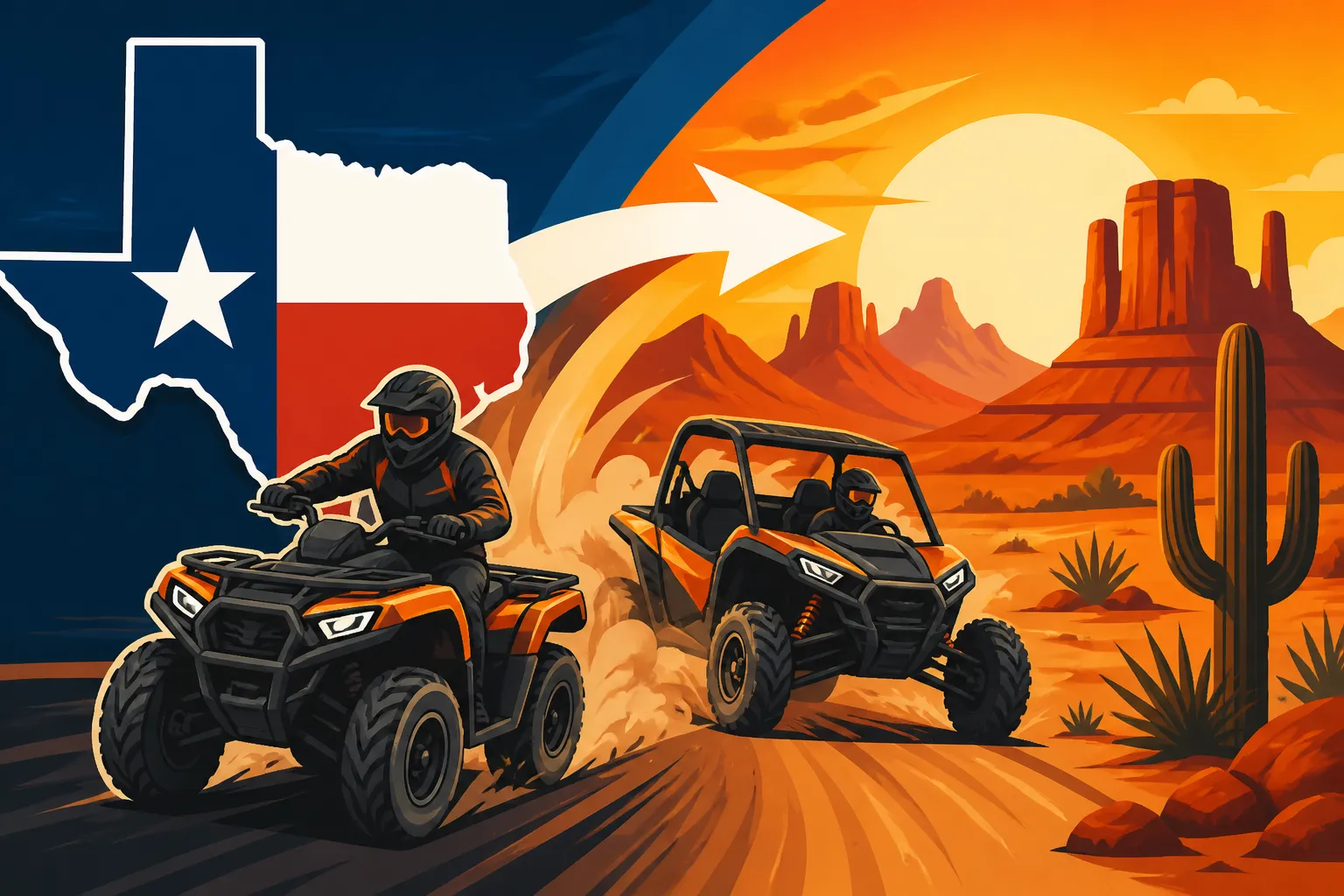
A Texas title, registration, or off-road credential does not automatically satisfy Arizona’s requirements for riding public land. Before hauling an ATV or UTV west, sort out the Arizona nonresident OHV decal, any required education, and access rules for your route. The key is to treat vehicle paperwork, land permission, and street use as separate questions.
Does Texas Registration or an Off-Road Credential Carry Over?
Usually, a Texas registration or off-road credential is not a substitute for Arizona’s nonresident OHV decal when an eligible off-highway vehicle is ridden in Arizona. Arizona has its own decal requirements for OHVs used in covered areas. A Texas plate, title, or proof of ownership helps identify the machine, but it does not by itself grant access to Arizona trails.
The term “reciprocity” can be misleading here. A Texas document may be useful evidence about your vehicle, but do not assume that it replaces an Arizona-specific requirement. Start with Arizona’s Non-Resident OHV Decal and Resident Decals Versus Visitor Decals in Arizona to see which category applies to your machine and trip.
Before buying anything, check how Arizona classifies your ATV or UTV. The rules can depend on the vehicle’s configuration, registration status, and use. In particular, the decal requirement is not the same as permission to ride any vehicle on any kind of land. If your machine is near a weight or vehicle-category threshold, confirm which rules apply rather than relying on its model name or Texas paperwork alone. Machines Under 1,800 Pounds explains why that distinction matters.
| Your machine and planned use | What to check before leaving Texas |
|---|---|
| ATV or UTV used off-highway on Arizona public land | Whether it needs Arizona’s nonresident OHV decal and whether each operator has an education requirement |
| Machine with Texas road registration and a plate | Whether its registration and equipment meet Arizona requirements for the roads you plan to use |
| Machine used on state trust land | Whether a separate recreational permit is required and whether the intended route is open |
| Machine used only on private property | The property owner’s permission and any rules that still apply to the vehicle or activity |
| Rental machine in Arizona | Whether the rental company handles the decal and what land or routes the rental agreement allows |
Arizona’s nonresident decal is a separate step, not a replacement for your Texas title or registration. For instructions on obtaining it, see Buying a Non-Resident Decal Online Only. Check the official Arizona process before your trip for current eligibility, application steps, and delivery details. Allow enough time for the decal to arrive and be attached as directed; do not assume a receipt or a Texas credential will work as a substitute.
Also check whether each person who will operate an OHV must complete Arizona’s education course. Requirements can depend on the operator and current rules, so avoid assuming that one driver’s completion covers the rest of the group. Safe and Ethical Riding in Arizona: the Course and Arizona Education Rules for Under-18 Riders are useful starting points. Confirm the current requirement and keep any course confirmation with your trip documents.
A decal is associated with the machine, not a general group pass. If you are bringing several vehicles, check the requirement for each one. A decal for one ATV does not automatically cover a second ATV or a side-by-side. The same principle applies if you lend a vehicle to a visitor: verify that the machine and its operator are properly prepared for the ride.
What to Arrange Before Riding Public Arizona Land
Think of the decal as one piece of the preparation, not the whole permission package. Arizona has different land managers and access rules. An OHV decal does not automatically authorize travel across every public parcel, use of every road, or staging at every trailhead.
For each planned ride, identify who manages the land and verify that motorized use is allowed on the exact route. Federal public land, state trust land, state parks, and local areas may have different maps, restrictions, closures, or permit requirements. A route shown in a phone app or shared by another rider is not proof that it is open.
State trust land deserves a separate check. Recreational access can require a permit, and the permit does not necessarily make every road or activity on a parcel permissible. Review Arizona State Trust Land Recreational Permits and Why a Decal Alone Will Not Let You Stage before choosing a place to park, unload, or ride. Check that the permit covers your planned activity and that the route is available to motorized vehicles.
Use current land-manager maps or notices when planning. A route can be closed, seasonally restricted, or limited to certain vehicle types. Maps may also distinguish a road from an off-highway route, which matters if your machine is not street legal. Reading an Arizona Motor Vehicle Use Map can help you understand what to look for, but verify that the map applies to the area and has not been superseded by a closure notice.
A practical planning sequence is:
- Pick the area and identify the land manager.
- Find the current map or route information for the specific trail or road.
- Check for closures, vehicle-width limits, permit requirements, and staging restrictions.
- Confirm whether the machine needs an Arizona nonresident decal.
- Check the education requirement for every person who will operate an OHV.
- Save the relevant permits, confirmations, and maps where you can access them without cell service.
Do this before loading the trailer. A route can look close to a public road on a map while crossing land with different access rules. If you are uncertain about a boundary, stop and verify rather than riding through and hoping the decal is enough.
Carry the documents that apply to your trip, along with identification and proof of ownership or registration. Keep a digital copy where practical, but do not rely on a phone connection in a remote area. A printed map and an offline copy of key information can be useful backups. For more on what a rider may be asked to show, see What an Arizona Officer Asks For.
Texas-Plated Street-Legal Machines Are a Different Case
An ATV or UTV that is registered for road use in Texas raises a different set of questions from an off-highway-only machine. A valid out-of-state plate may be relevant when a visitor travels on Arizona roads, but it does not automatically make every part of the vehicle compliant with Arizona road rules or authorize travel on roads where OHVs are prohibited.
Check three things separately:
- Registration: Is the vehicle currently registered for road use in Texas, and are its registration documents with you?
- Equipment and insurance: Does the vehicle meet the applicable requirements for the road use you intend, and is the insurance valid for that use?
- Route: Is the specific Arizona road open to the type of vehicle you are driving?
A machine with an off-highway decal is not thereby street legal. Likewise, a street-legal plate does not provide unlimited access to off-highway trails or land. The distinction between these permissions is explained in Street-Legal Plates in Place of an Arizona Decal.
Road access also varies. A route may be open to street-legal vehicles but closed to OHVs, or it may allow OHVs only on a designated section. Confirm the local and land-manager rules before using a road to connect trails or reach a town. Do not treat an interstate, highway, or paved shoulder as an automatic connector. For road use details, see Which Arizona Roads Allow OHVs.
If you are relying on Texas registration, bring the vehicle’s current registration documents and proof of insurance, then check whether Arizona recognizes the vehicle’s road status for the planned use. Be especially careful with a machine that is licensed in Texas but has been modified, has a temporary permit, or is being transported under paperwork that does not authorize ordinary road operation. If its status is unclear, resolve that before the trip rather than at a trailhead.
A street-legal side-by-side may still need to follow ordinary road rules, and Arizona access rules can differ from those in Texas. A road legal in one state is not necessarily open to OHVs in another. For a mixed trip involving paved connectors and trails, plan each segment separately and confirm the vehicle is permitted on each one.
A Border-Trip Checklist for Texas Riders
A little preparation prevents the most common problem: arriving in Arizona with a properly titled machine but missing a separate decal, permit, or route authorization. Use this checklist before departing.
For each machine:
- Confirm whether it is an off-highway-only machine or registered for street use.
- Check whether Arizona requires a nonresident OHV decal for the planned use.
- Apply through the official process and follow its current instructions for placing the decal.
- Bring the Texas title or registration documents that apply to the machine.
- If the machine is street legal, check road equipment, registration, insurance, and route rules separately.
- If you are hauling more than one machine, verify the requirement for each one.
For each operator:
- Confirm whether Arizona’s education requirement applies.
- Complete any required course before the trip and keep the confirmation available.
- Check age-related riding rules for young operators and passengers.
- Make sure each rider understands which routes and land areas are allowed.
For the route and land:
- Identify the land manager for every planned riding area.
- Check current route maps, closures, and vehicle restrictions.
- Confirm whether a state trust land permit or other authorization is needed.
- Verify that the place you plan to unload and park allows staging.
- Save offline maps and essential documents before entering areas with limited service.
If your plans include renting a machine after you arrive, do not assume that a rental follows the same paperwork arrangement as your own ATV or UTV. Ask the rental provider whether the machine’s decal requirements are handled, which routes the agreement permits, and whether the route you intend to ride is open. Arizona Decal Rules for a Rented Machine covers that separate situation.
When details are unclear, ask the relevant agency or land manager about the exact machine, location, and activity. A general answer about “Arizona OHV rules” may not settle whether a particular road is open or whether a particular parcel needs a permit. Keep the answer tied to your actual route.
The simplest rule for a Texas rider is this: bring your Texas paperwork, but do not count on it to replace Arizona’s own OHV decal or land-access requirements. Confirm the machine category, operator requirements, permits, and route before loading up. That makes it easier to spend the trip riding the places you planned instead of sorting out paperwork at the trailhead.
Disclaimer
This article is for general informational purposes only and does not constitute professional advice. Laws, prices and regulations vary by location and change over time. Consult a qualified professional for guidance on your specific situation.