Registering More Than One Machine
When you're passionate about hitting the Arizona trails, it's easy to accumulate a few different machines. Maybe you've got a side-by-side for family adventures, a trusty ATV for solo exploration, and a dirt bike for the kids. But owning more than one off-highway vehicle (OHV) in Arizona can sometimes feel like you're drowning in paperwork, trying to keep track of individual registrations, titles, and those all-important annual decals. This guide is here to help you navigate the process of registering multiple ATVs and UTVs in Arizona, making it less of a headache and more about getting out there to ride.
Why Registering Multiple Machines Feels Like a Chore
Let's be honest, few things are as exciting as bringing a new machine home, whether it's a shiny new UTV from the dealership or a well-loved quad you scored from a private seller. That initial thrill can quickly turn into a groan when you remember all the administrative hoops you have to jump through. It's not just one big "family OHV registration" form; each machine is treated as a completely separate entity by the Arizona Motor Vehicle Division (MVD), and that's where the complexity often kicks in.
The Paperwork Mountain for Each Machine
Imagine for a moment you've just acquired three new-to-you machines: a sleek Polaris RZR, an older Honda Foreman ATV, and a small Kawasaki for your growing teenager. For each of these machines, you're going to need to present specific documentation. This isn't a bulk process where you can submit one proof of residency and get three decals. No, the MVD wants to see a unique certificate of title, a valid bill of sale, and often an odometer disclosure statement (if applicable) for each individual vehicle.
It's about ensuring clear ownership and proper identification for every single off-highway vehicle that will be hitting public lands. This means digging up the Vehicle Identification Number (VIN) for each machine, ensuring it matches the paperwork, and often confirming the engine size and year model. When you're dealing with multiple sellers or different purchase dates, keeping all that distinct information organized for submission can be a real feat. It's not uncommon for folks to accidentally mix up a VIN from one machine with the title application for another, leading to delays and frustration at the MVD counter.
Juggling Different Purchase Scenarios
The way you acquired each machine can also significantly impact the registration and titling process. It’s rarely a uniform experience across your entire fleet. For instance, if you bought a brand-new side-by-side from an Arizona dealer, they often handle much of the initial paperwork for you, including submitting title applications and sales tax. This is typically the smoothest path, as the dealer is well-versed in the requirements and processes. They usually just need your signature and payment.
However, if you picked up that vintage ATV from a private seller on Craigslist, the onus is entirely on you to gather the correct documents. This means making sure you have a proper bill of sale that clearly outlines the transaction, includes the VIN, and is signed by both you and the seller. Then there's the inherited machine from a family member, which might require additional paperwork like a death certificate or a small estate affidavit to prove legal transfer of ownership. Each unique acquisition method brings its own set of forms and potential challenges, making the task of registering multiple machines feel like assembling several different puzzles simultaneously.
Streamlining the Arizona Registration Process for Your Fleet
While the MVD treats each of your OHVs as a separate entity, that doesn't mean you can't implement strategies to make the overall management of your fleet's paperwork much smoother. Being proactive and organized is truly the secret weapon here, especially when you have several machines to keep track of.
Centralizing Your Documentation
One of the biggest hurdles when owning multiple OHVs is simply keeping track of all the distinct documents. Imagine fumbling through a stack of papers, trying to find the title for your Yamaha Wolverine while standing at the MVD counter. It’s a recipe for stress. Instead, create a dedicated system for your OHV documentation. This could be a physical binder with a separate section for each machine, clearly labeled with the make, model, and VIN. Or, for the more digitally inclined, scan all your important documents – titles, bills of sale, insurance cards, and decal receipts – and save them in organized digital folders on your computer or a cloud service.
Think of it this way: when you need to renew your annual OHV decal, you'll know exactly where to find the previous registration. If you ever sell one of your machines, having all the [What an Arizona Bill of Sale Should Carry] information and the [Proof of Ownership for an Arizona Title] readily accessible will make the transaction go much smoother. A quick tip: many people use services like LawDepot to generate legally sound bills of sale or other essential documents when buying or selling privately, ensuring they capture all the necessary details for MVD. This centralized approach makes dealing with the MVD, insurance companies, or even potential buyers much less of a chore.
Understanding Individual Decal and Title Requirements
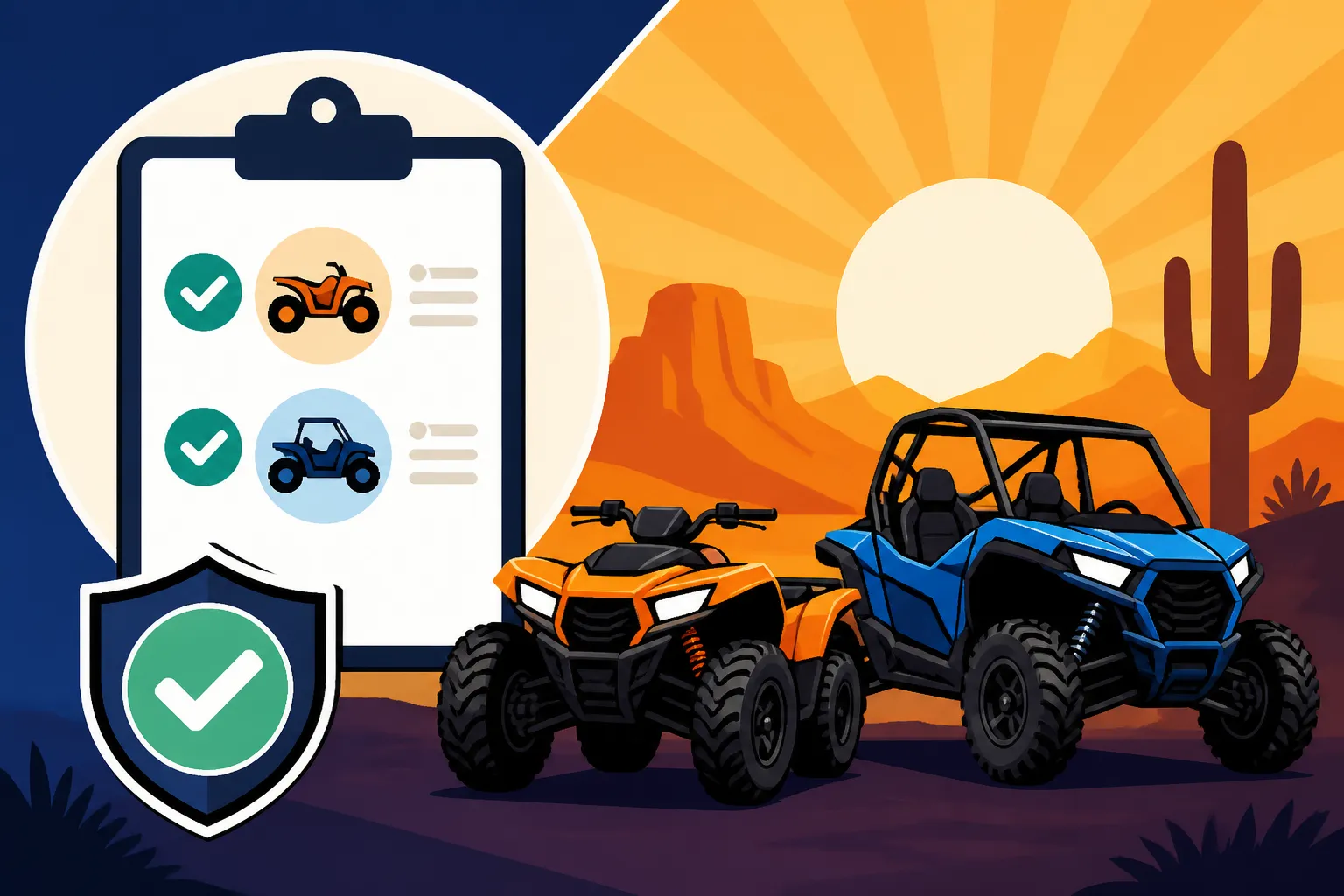
It’s crucial to understand that in Arizona, every single OHV you own, if ridden on public lands, needs its own specific annual decal and its own distinct [Arizona Certificate of Title for an Off-Highway Vehicle]. There's no such thing as a "family decal" that covers all your machines. Each VIN corresponds to a single title and a single decal. This means if you have three machines, you'll need three separate titles and three separate decals purchased annually.
Let's break it down in a table to show what each machine needs:
| Requirement | Side-by-Side (e.g., RZR) | ATV (e.g., Foreman) | Dirt Bike (e.g., KX) |
|---|---|---|---|
| Certificate of Title | Yes, unique to VIN | Yes, unique to VIN | Yes, unique to VIN |
| Annual OHV Decal | Yes, unique to VIN | Yes, unique to VIN | Yes, unique to VIN |
| Proof of Ownership | Required for titling | Required for titling | Required for titling |
| Insurance | Recommended, often required if street-legal | Recommended | Recommended, often required if street-legal |
| Emissions Test | If street-legal in metro area | If street-legal in metro area | If street-legal in metro area |
Understanding this individual requirement for each machine is key to avoiding penalties. The [Arizona's Annual OHV Decal Explained] details why these decals are so important and what they fund for trail maintenance and rider safety. The process for [Arizona MVD OHV Registration Explained] applies to each machine individually, requiring its own application and fee. It's a system designed to track individual vehicles, not a collection of them.
Practical Tips for Multi-Machine Owners
Managing a small fleet of OHVs can feel like a part-time job if you don't have a good system in place. But with a few practical tips, you can significantly reduce the administrative burden and spend more time riding.
Leveraging Online and Third-Party Services
One of the greatest conveniences for multi-machine owners is the availability of online services and authorized third-party MVD providers. While you might have to visit an MVD office in person for initial titling of a new-to-you machine, especially if the ownership transfer is complex, many subsequent tasks can be handled remotely. The Arizona MVD's online portal is a fantastic resource for [Renewing an Arizona Decal Online] for all your machines. Once you've created [The Arizona Portal Account Every Rider Needs], you can link all your registered vehicles and renew each decal with just a few clicks. This saves you countless trips to a physical office, especially if you have several machines whose renewals are due at different times of the year.
Beyond the official MVD website, don't forget about third-party MVD providers. These are privately owned businesses authorized by the state to perform many MVD services, including registrations and renewals. Often, their wait times are shorter, and their customer service can be more personalized, which is a huge bonus when you're trying to process paperwork for multiple vehicles. They can be invaluable when [Registering Through Arizona MVD or a Third Party] and you want to ensure everything is done correctly the first time.
Handling Renewals for a Fleet
Since each machine has its own distinct registration and decal expiration date, trying to remember when each one is due can be a logistical nightmare. If you buy machines at different times throughout the year, their renewal dates will likely be staggered. This means you could be remembering to renew one in March, another in August, and a third in December.
To avoid missing a deadline and incurring late fees or the risk of riding undecaled, consider setting up a robust reminder system. The MVD does send out [Renewal Reminders From Arizona MVD], but those can sometimes get lost in the mail or overlooked. Instead, mark down each machine's [When an Arizona OHV Decal Expires] date on a shared family calendar, set recurring alerts on your phone, or use a spreadsheet to track everything. Some owners even try to consolidate renewal dates, if possible, by renewing decals a little early so they all fall within the same month, making it easier to manage. Having a clear system means you won't get caught out on the trail with an expired decal, potentially leading to fines.
Ensuring Proper Ownership for Resale or Transfer
Even if you plan to ride your machines forever, life happens. You might decide to upgrade, sell one to a friend, or pass it down to a family member. When that day comes, having perfectly clear and complete ownership documents for each machine will make the process infinitely smoother. Trying to sell a machine without a title or with incomplete paperwork is a major headache, both for you and the buyer. This is where meticulous record-keeping truly pays off.
Ensure that the [Arizona Certificate of Title for an Off-Highway Vehicle] for each of your machines accurately reflects the current owner(s) and that there are no liens if the machine has been paid off. If you've financed a machine, make sure you receive the lien release paperwork once the loan is satisfied and update the title accordingly. When selling a machine, a comprehensive bill of sale is critical. Again, tools like LawDepot can assist you in creating legally sound transfer documents, preventing future disputes or issues for the next owner. Proper documentation also makes processes like [Transferring an Arizona OHV After a Death] or handling a situation where you're [Selling a Quad in Arizona With No Title] far less complicated, though it's always best to have a clean title from the start.
Common Pitfalls and How to Avoid Them
Even the most organized multi-machine owner can run into snags. It's often the small oversights that lead to the biggest headaches. Being aware of these common pitfalls can save you time, money, and frustration.
Mixing Up VINs and Paperwork
This is perhaps the most common mistake when dealing with multiple OHVs. You're filling out a form, you grab a title, and without double-checking, you might accidentally copy the VIN from your utility UTV onto the title application for your sport quad. While it seems like a simple error, it can lead to significant delays. The MVD's system relies heavily on accurate VINs to link vehicles to their owners. An incorrect VIN can result in your application being rejected, requiring you to restart the process, or worse, creating a mess on your official record that's difficult to untangle.
Always, always double-check the VIN on any form against the physical VIN plate on the machine itself. Take a photo of the VIN for each machine and label it clearly in your digital files. When dealing with multiple paper titles, keep them in separate, labeled sleeves or folders to prevent them from getting mixed up. This small habit can save you the major headache of having to correct a VIN on an Arizona record later down the line.
Forgetting the Annual Decal for Just One
It's easy to get into a rhythm of renewing your main riding machine's decal every year. But what about that secondary ATV that only gets ridden a couple of times a year, or the kids' smaller dirt bike that's mostly used on private land but occasionally ventures onto public trails? Many multi-machine owners have found themselves in a bind because they simply forgot to renew the annual OHV decal for just one of their machines.
The consequence? If you're out riding on Arizona's beautiful public lands – whether it's a forest road, a BLM trail, or even crossing a short section of county road to get to the trailhead – every OHV needs a current, valid decal. An Arizona Ranger or Game and Fish officer will check for it. Getting caught with an undecaled machine can result in [Penalties for an Undecaled Machine in Arizona], which can include fines. It's a bummer to have an otherwise perfect ride interrupted by a citation. When an Arizona officer asks for your papers, you'll want to present all the necessary documentation for that specific machine, including a valid decal. Don't let that "forgotten" machine become an expensive oversight.
Disclaimer
This article is for general informational purposes only and does not constitute professional advice. Laws, prices and regulations vary by location and change over time. Consult a qualified professional for guidance on your specific situation.