Camping on Arizona State Trust Land
Camping on Arizona State Trust Land can be a quiet way to spend a night outdoors, but it is not the same as camping on unrestricted public land. You need to confirm that your permit covers the activity, that the parcel is open, and that access and fire rules allow your plan. Here’s how to check those details before you drive out.
Confirm the land, permit, and access
Arizona State Trust Land is managed for the benefit of designated beneficiaries. It is not simply public land that anyone can use for recreation. Before planning an overnight stay, confirm that the ground you want to use is State Trust Land and that you have the right recreational permit for your activity.
Start with the basics:
- Identify the parcel. Check land-status maps and parcel information rather than relying on a pin, trail name, or map color alone. Nearby parcels may have different owners or access rules. For a primer, see Which Arizona Land Is Trust Land and Telling Trust Land From BLM Ground.
- Check the permit’s terms. Review the current permit information from the Arizona State Land Department. A recreational permit is not a blanket right to enter every parcel or camp anywhere on it. See Arizona State Trust Land Recreational Permits and Trust Land Activities a Permit Covers.
- Confirm the area is open. Look for closures, access restrictions, and parcel-specific notices close to your trip. A permit does not override a closure or give permission to cross land you are not authorized to use.
- Verify the route in. Make sure the road or trail you plan to use is legal and actually reaches the parcel. Permission to recreate on Trust Land does not automatically grant a right to cross private property, tribal land, or another restricted area.
| What to verify | Why it matters | Where to check |
|---|---|---|
| Land ownership and parcel boundary | A campsite that looks open may be on a different type of land | Current land-status maps and parcel information |
| Permit activity and conditions | A permit’s scope and limits determine what use is authorized | Current Arizona State Land Department permit terms |
| Closures and access | Parcels, roads, and routes may have restrictions | Current notices from the land manager |
| Fire conditions | Fire rules can change with conditions and location | Current local and land-manager fire notices |
| OHV route legality | A camping permit does not make every road or trail open to vehicles | Current route maps and applicable land rules |
If you are unsure which permit applies, check Individual Versus Family Trust Land Permits and How Long an Arizona Trust Land Permit Lasts. The permit’s current wording matters more than assumptions based on what another camper did on a different parcel. If a specific site or activity is unclear, contact the Arizona State Land Department before setting out; Arizona State Land Department Offices can help you find the appropriate contact.
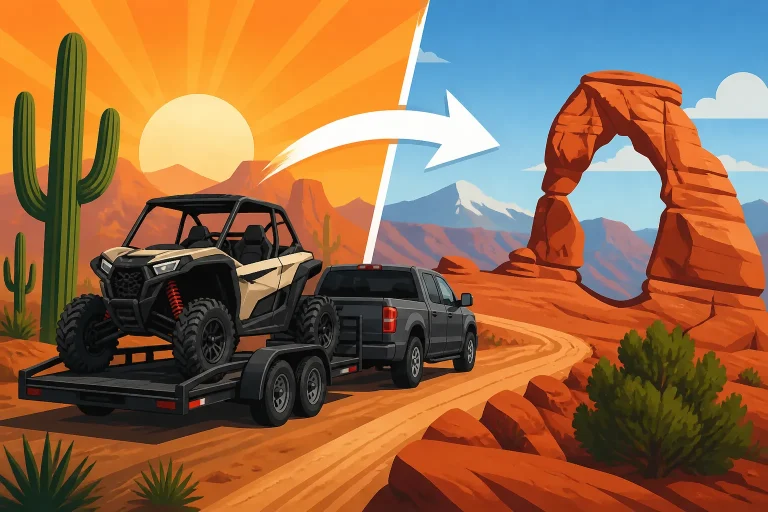
Also separate the camping question from the driving question. A permit that authorizes recreational access does not necessarily authorize every motorized route, every staging area, or every way of reaching a campsite. Check Crossing Arizona State Trust Land and Staging a Trailer on Trust Land if your trip includes an ATV or UTV, a trailer, or a planned drive across Trust Land.
Plan a campsite that fits the rules
Do not choose a campsite solely because it is flat, scenic, and reachable. First make sure camping is allowed under the current permit conditions and any rules for the particular area. Then pick a site that keeps your group on durable ground and avoids creating problems for other visitors, land users, or the surrounding habitat.
A little advance planning prevents common mistakes:
- Choose a spot well inside the permitted parcel. GPS devices and phone maps can drift, especially in remote areas. Use more than one source to check boundaries, and leave room for uncertainty rather than setting up right beside a boundary.
- Stay on established routes. Do not cut a new track to reach a preferred camp spot. A short cross-country shortcut can damage vegetation and soil, and it may also take you into an area where vehicle use is not allowed.
- Keep camp compact. Set up tents, chairs, and cooking equipment in one previously disturbed area where possible. Avoid spreading vehicles and gear across open ground.
- Protect water and drainage features. Do not camp in a wash or low drainage channel. Desert washes can flood suddenly, including when rainfall is far upstream. Give waterways and other sensitive areas space.
- Respect nearby use. State Trust Land may be used for permitted activities beyond recreation. Leave room for ranch operations, gates, livestock, and working vehicles. Do not block a road, gate, or access point.
Do not assume a permit guarantees a campsite
A recreational permit is not a reservation for a particular site. Another permitted visitor may already be using the area, access may be limited, or a closure may change your plans. Have a second option that is also legal, and be ready to leave if you cannot confirm that your intended spot is available and permitted.
Camping rules can also differ from rules on adjacent land. A map may show State Trust Land next to Bureau of Land Management land or private property, but the boundaries do not merge their rules. If your route crosses several land types, confirm what applies on each segment rather than treating the whole route as one continuous recreation area.
For general information on the scope of activities, consult Trust Land Activities a Permit Covers. For a trip that includes parking or unloading a machine, review Parking on Arizona Trust Land as well. Do not assume that permission to camp includes permission to leave a trailer, stage vehicles, or store equipment wherever it is convenient.
Bring an ATV or UTV only when the route and use are allowed
An ATV or UTV can make a remote campsite easier to reach, but it also adds a separate set of checks. The camping permit does not, by itself, establish that a particular route is open to OHVs. Confirm the route’s status, any vehicle restrictions, and the conditions for accessing the parcel before loading the machine.
Plan the vehicle portion of the trip carefully:
- Use an authorized route. Follow current route information and posted signs. Do not drive around a closed gate, create a bypass, or leave an established route to avoid an obstacle.
- Check staging and trailer plans. Decide where the tow vehicle and trailer may legally park. If your plan involves unloading on State Trust Land, check the applicable rules before arrival.
- Keep riding separate from camping permission. A permit or campsite plan does not automatically cover a ride across neighboring parcels or onto another land manager’s property.
- Carry the documents and information you need. Keep permit details accessible, along with a map or offline navigation plan. Cell coverage can be unreliable, and a screen that depends on a live connection may not help when you need to verify a boundary.
- Use the machine responsibly. Stay within passenger and equipment limits, keep noise considerate, and avoid disturbing livestock or other land users. Pack out trash and do not leave vehicle fluids, food, or other waste behind.
If your trip crosses State Trust Land to reach another destination, review Crossing Arizona State Trust Land rather than assuming a direct line on a map is a legal route. And if you are bringing a trailer, Staging a Trailer on Trust Land addresses a separate question from whether overnight camping is allowed.
Check fire restrictions before you travel
Fire rules can change with weather, local conditions, and land-management decisions. Do not rely on an old trip report, a sign you saw in another area, or a general assumption that a small campfire is permitted. Check current restrictions for the parcel and the route you will travel, then follow any posted conditions.
If fires are prohibited or the rules are unclear, plan to camp without one. A stove may also be subject to restrictions, so verify the current notice instead of assuming it is automatically allowed. Keep any permitted flame attended and fully extinguished before leaving; never leave hot coals or embers behind.
The same caution applies during dry, windy weather. A restriction can change after you have made your plans, and conditions in one part of Arizona may not match conditions somewhere else. Check the relevant updates shortly before departure and again if your trip spans multiple areas.
Leave the land as you found it, and confirm before each trip
A good Trust Land campsite should be easy to leave without evidence of the stay. Pack out all trash, food scraps, and disposable items. Do not bury garbage or burn it. Keep wastewater and human waste handled in a way that follows current land rules and local guidance, and avoid leaving anything that could attract wildlife or livestock.
Before breaking camp, do a slow walk around the site. Check for small items such as food wrappers, tent stakes, bottle caps, and fire debris. Make sure the vehicle is fully off the travel route and that no equipment has been left behind. Close gates only as instructed, and do not alter fencing, signs, or land features.
Use this short pre-trip checklist:
- Permit is current and covers the planned recreational use.
- The campsite parcel and route have been checked against current land information.
- No closure or access restriction affects the plan.
- Camping, parking, staging, and OHV use have each been checked separately.
- Fire restrictions and weather conditions have been reviewed.
- A backup destination is available if access or conditions change.
- Maps or navigation information are available offline.
- The group has a plan for trash, waste, water, and safe vehicle recovery.
The safest habit is to repeat these checks for each trip rather than assuming that a location remains open because it was accessible before. Conditions, notices, boundaries, and permit terms can change. If you cannot confirm that camping and access are allowed, choose another destination or get clarification before setting up camp.
Disclaimer
This article is for general informational purposes only and does not constitute professional advice. Laws, prices and regulations vary by location and change over time. Consult a qualified professional for guidance on your specific situation.