Rain 20 Miles Away and a Flooded Canyon
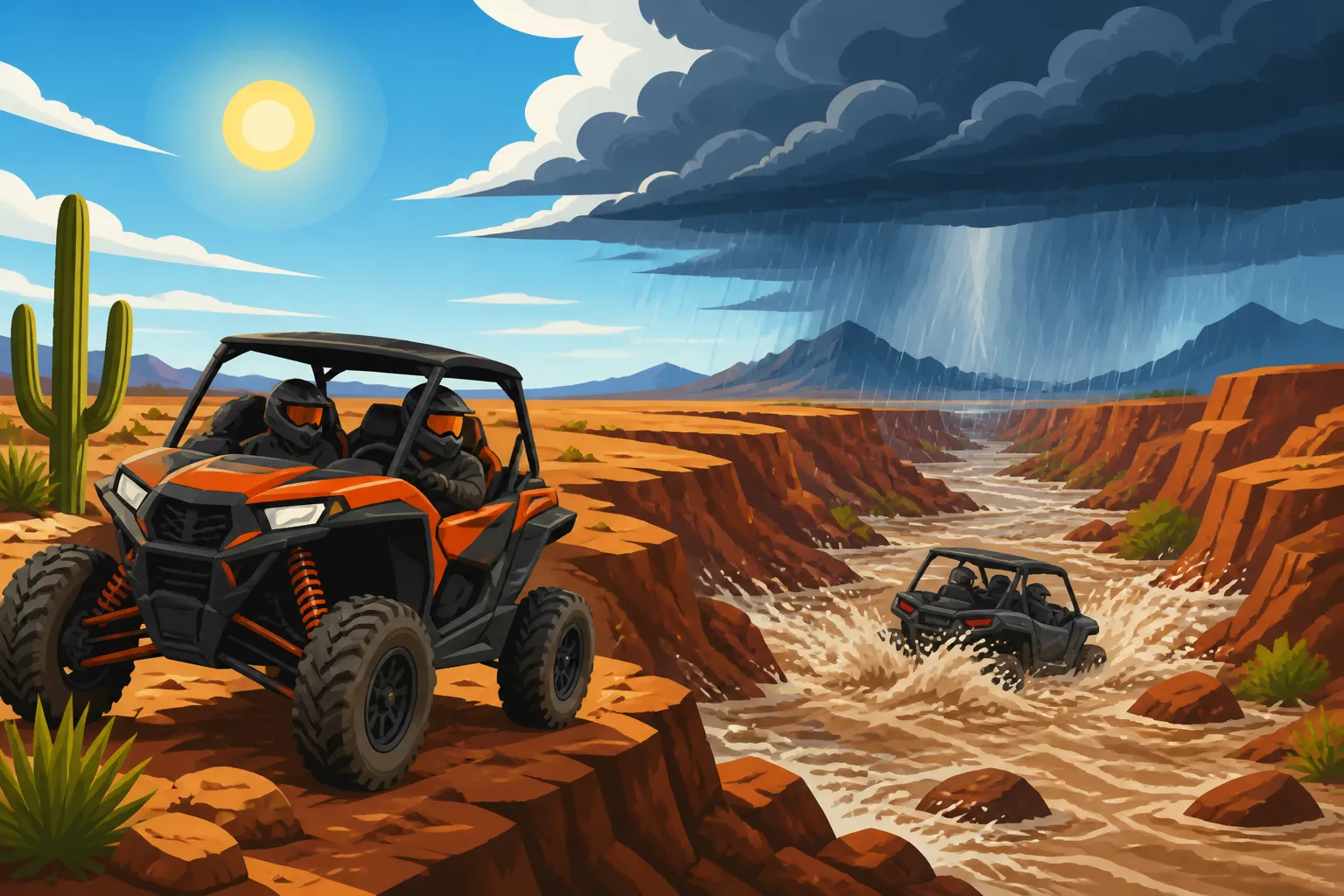
A blue sky over your trail does not mean the canyon ahead is safe. In Arizona, rain can fall miles away, run downhill through a watershed, and reach a dry wash with little warning. This guide explains why that happens, how to assess your route before and during a ride, and what to do when water or weather makes a canyon unsafe.
Why distant rain can flood an Arizona canyon
Water follows the watershed, not the sky above you
A wash can look harmless when its bed is dry, but it may collect runoff from a much larger area than the narrow stretch you can see. Rain falling on higher ground can travel downhill through gullies and tributaries, then funnel into a canyon where the skies are still clear. The flow may arrive after the storm has moved on or before you hear thunder.
That is why looking up at the sky directly above your ATV or UTV is not enough. A storm over a distant ridge can still affect the route below it. In Arizona, this matters especially in steep, rocky terrain, where water drains quickly into narrow channels. It also matters on broad desert routes: a shallow-looking wash can receive runoff from a far wider drainage network.
If your route includes a canyon, wash, creek crossing, or low point, treat upstream weather as relevant weather. A dry channel is not proof that the route will stay dry. The danger is not limited to dramatic, deep water, either. Fast-moving water can carry mud, branches, and rocks, and can make the bottom difficult to see or the banks unstable.
Narrow canyons and desert washes leave little room to react
In a wide, open area, you may have space to stop, turn around, or move to higher ground. A confined canyon can take those options away. Steep walls, loose rock, side channels, and narrow bends may leave no safe place to pull off once water begins to rise. Even before water reaches the trail, runoff can wash out a crossing, cover obstacles, or undercut a bank.
A route that was easy on the way in can become a trap on the way out. This is one reason not to ride deep into a drainage simply because it is dry at the trailhead. Think ahead to the terrain beyond the next bend. If there is no safe place to turn around or climb out, reconsider entering while storms are possible anywhere in the watershed.
For a fuller explanation of this hazard, see Flash Flooding in a Desert Wash and Arizona Monsoon Season and Flash Flooding. The key point is simple: rain does not have to fall where you are for a wash or canyon to flood.
How to assess weather and route risk before riding
Check the whole route, not just the staging area
Before unloading, look at the weather for the broader area around your route, including higher terrain and the watersheds that feed the canyons or washes you plan to cross. A forecast for the nearest town may not tell the whole story. Conditions can vary between the Phoenix lowlands, the higher ground around Four Peaks, and the country around Sedona or Flagstaff.
Check for weather alerts and land or trail closures, and make a fresh assessment before you leave the staging area. If storms are forecast anywhere upstream, postponing a canyon route is often the safer choice. Be especially conservative when the plan depends on crossing a wash more than once; a route that is easy to enter can become difficult or impossible to exit.
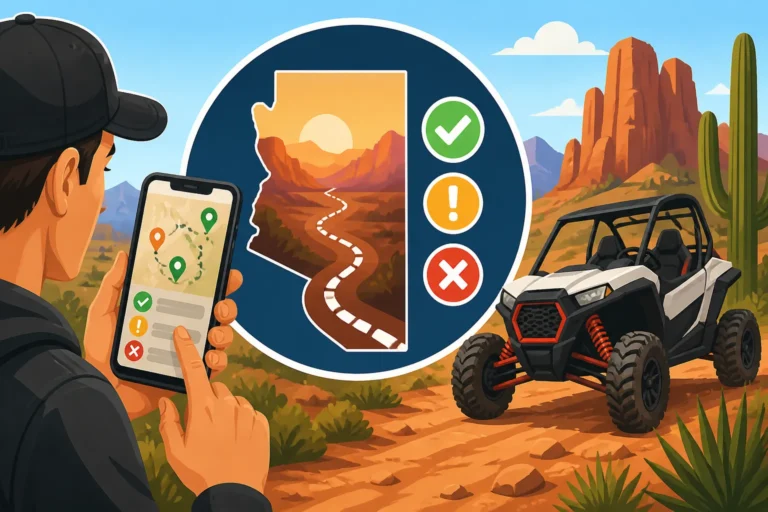
A map can help you understand the terrain, but it cannot tell you that a crossing is safe right now. Apps such as onX Offroad can help riders review a planned route and identify nearby terrain or alternate routes, but use them as planning tools rather than a substitute for weather alerts, current closure information, or judgment on the ground. Before driving to a trailhead, review Checking Arizona Trail Status Before You Drive and Reading an Arizona Motor Vehicle Use Map.
Build a route plan with room to change course
A useful ride plan includes more than a destination. Note the washes, canyon sections, low crossings, and possible exit routes along the way. Share the route and your expected return time with someone who is not riding with you. If you change plans, let that person know when you have a reliable way to do so.
Decide in advance what conditions will make you turn around. For example, you might agree that any thunder, a weather alert for the watershed, fresh runoff, or a rapidly changing sky means the group will leave the drainage. Setting that rule before the ride helps avoid the familiar pressure of “just getting to the next turn” when the group has already invested time in the route.
| What you notice | Why it matters | Safer response |
|---|---|---|
| Storms or alerts upstream | Runoff may reach your route even in clear weather | Avoid entering the drainage or leave before conditions worsen |
| Thunder, darkening skies, or gusting winds | Weather may be changing faster than expected | Turn toward safer, higher ground and reassess |
| Muddy water, floating debris, or a rising waterline | Water is moving through the channel | Do not enter or cross; move away from the drainage |
| A blocked, washed-out, or altered crossing | The route may no longer be passable | Turn around if safe and choose a known alternative |
| Poor visibility or uncertain route conditions | You may not see hazards or a safe exit | Stop in a safe location and avoid pressing farther in |
Offline maps can be helpful when cell service disappears, but they are not live flood sensors. Download or save your route information before leaving service, and have a paper map or another navigation option if practical. For related planning advice, see [Cell Dead Zones in the Arizona Backcountry] and Getting Turned Around in the Sonoran Desert.
What to do when weather changes during a ride
Leave the drainage early, before water arrives
If you hear thunder, see a storm building, receive a warning, or notice runoff beginning, do not wait to see whether the water will reach you. Leave a narrow wash or canyon as early as you can, using a known route to higher ground. Avoid stopping in the channel to debate the decision or gather equipment. If your group is spread out, communicate clearly and keep everyone together while moving out.
Do not assume that a small trickle will remain small. Water can rise quickly, and a crossing can change while you are watching it. Never attempt to drive, ride, or walk an ATV or UTV through moving floodwater. The depth, speed, and condition of the ground beneath it are hard to judge, and debris or a washed-out edge may be hidden from view.
If the route out is already affected, do not gamble on crossing. Move away from the channel toward higher ground if that can be done without entering another drainage or exposing yourself to a separate hazard. Keep away from banks that may be unstable. If anyone is in immediate danger, call emergency services when possible and give your location using landmarks, route names, or coordinates you recorded earlier.
Avoid the common “we can probably make it” mistakes
A familiar crossing can feel safe because you crossed it on the way in. But a crossing is not a fixed condition: rain upstream can change the flow, deepen the channel, move rocks, and soften the approach. Do not rely on tire size, ground clearance, a winch, or another rider’s past experience to make a flooded crossing safe.
It is also risky to stop in a low spot to take photos, wait for the storm to pass, or check a phone. If you are still in a drainage, move to safer ground rather than staying to observe. If you are already on high ground, stay there until conditions have clearly improved and you have checked whether the route remains passable and open. A cleared sky alone does not prove the water has receded or the trail is intact.
If a group member gets stuck or separated, do not send other riders into moving water to help. Contact emergency services if needed and provide the best location details you have. Water Planning for an Arizona Trail Day can help with broader preparation, but remember that carrying water for yourself is different from planning for a sudden flood hazard.
Safer habits for Arizona ATV and UTV canyon routes
Choose routes and timing with weather in mind
A good route choice is one you can safely abandon. If the forecast suggests storms, choose a ride with open terrain, multiple exits, and fewer narrow drainages, or reschedule. Conditions may differ sharply by elevation, so a cooler morning in the desert does not guarantee that a storm is not forming over higher ground. In monsoon season, build flexibility into the day rather than treating the planned route as a commitment.
When choosing a trail, consider the entire drainage and not just the section that looks fun on a map. A canyon route with steep sides and limited exits deserves a more conservative weather decision than an open loop with nearby higher ground. For broader seasonal context, see Arizona Monsoon Season and Flash Flooding. For route-specific planning, use current land-manager information alongside maps, and remember that a marked route does not guarantee safe conditions.
Prepare your group to turn around without hesitation
Before you ride, agree that anyone can call a stop or turn-around without having to persuade the whole group. This matters when riders have different experience levels, when children are along, or when one person is eager to finish a loop. A calm, agreed-upon rule makes it easier to act early instead of waiting until the situation feels urgent.
Keep the group close enough to communicate, especially near washes and canyon crossings. Identify a meeting point on higher ground in case riders become separated, and make sure everyone knows how to use the group’s navigation tools. If you use onX Offroad to review a route, make sure each rider understands the route and has a backup plan for navigating without a signal. The goal is not to follow an app line at all costs; it is to make a clear decision when conditions change.
A quick reminder before heading out:
- Check weather and alerts for the route and the terrain feeding its drainages.
- Mark washes, canyon sections, and possible exits before leaving service.
- Tell someone your route and expected return time.
- Turn around early if storms, thunder, rising water, or fresh runoff appear.
- Never attempt to cross moving floodwater, no matter how familiar the route seems.
The most important decision may be the one made before the ride begins: choosing not to enter a canyon when storms are possible upstream. A canceled loop is frustrating, especially after a long drive and a loaded trailer. But it is far better than discovering that the only way out has become a flooded wash.
Disclaimer
This article is for general informational purposes only and does not constitute professional advice. Laws, prices and regulations vary by location and change over time. Consult a qualified professional for guidance on your specific situation.