Dispersed Camping Near Arizona Trailheads
Camping near an Arizona ATV or UTV trailhead can make an early start easier, but a convenient pullout is not automatically a legal campsite. Land ownership, fire restrictions, access roads, and vehicle rules can change within a short distance. This guide explains how to choose a suitable dispersed campsite, confirm that you may stay there, and plan a ride without putting your group or the landscape at risk.
Start by confirming who manages the land
Public land is not one set of rules
A spot that looks remote may be managed by the Bureau of Land Management, the U.S. Forest Service, Arizona State Land Department, a tribal government, a county, or a private landowner. Each can have different rules about dispersed camping, vehicle access, fires, group size, and how long you may stay. In Arizona, property boundaries can run close together, so a campsite that appears to be part of a trail system may actually be on land with different restrictions.
Before choosing a spot, identify the land manager for both the campsite and the route you plan to ride. Check the relevant agency’s current maps and notices, and look for signs at the road or trailhead. A road’s open status does not automatically mean camping is allowed beside it, and permission to camp does not automatically authorize driving an ATV or UTV across the surrounding area.
This is especially important around popular riding destinations. Areas near Sedona, Flagstaff, Lake Havasu City, and the Phoenix metro area may include a mix of federal, state, tribal, and private land. A map app can help you understand the landscape, but use it as a planning aid rather than final permission. The guide to [Telling Trust Land From BLM Ground] can help explain why identifying the land manager matters before you set up camp.
Treat State Trust Land and tribal land separately
Arizona State Trust Land is not simply open public camping land. Access for recreation is controlled by permit and land-use rules, and a permit should not be treated as permission to camp or ride anywhere you choose. Check the applicable rules for your intended activity and location before heading out. The details matter: access for one kind of recreation does not necessarily authorize every other use.
The same caution applies to tribal lands. Tribal governments manage their own land and access rules. Do not assume that a route shown near a reservation, or a dirt road that appears to connect two public areas, is open to the public. Confirm access through the appropriate tribal authority or stay on routes that are clearly open to public use.
If your planned ride crosses more than one land type, research each segment separately. A common planning mistake is checking the campsite but not the ride route, or checking the route but not where the trailer and camp will sit. For more on the distinction between public riding access and permit requirements, see [Arizona Trails on State Trust Land] and [Arizona Recreational Permits for Individuals].
Choose a campsite that works for your vehicle and your ride
Separate your campsite from your riding route
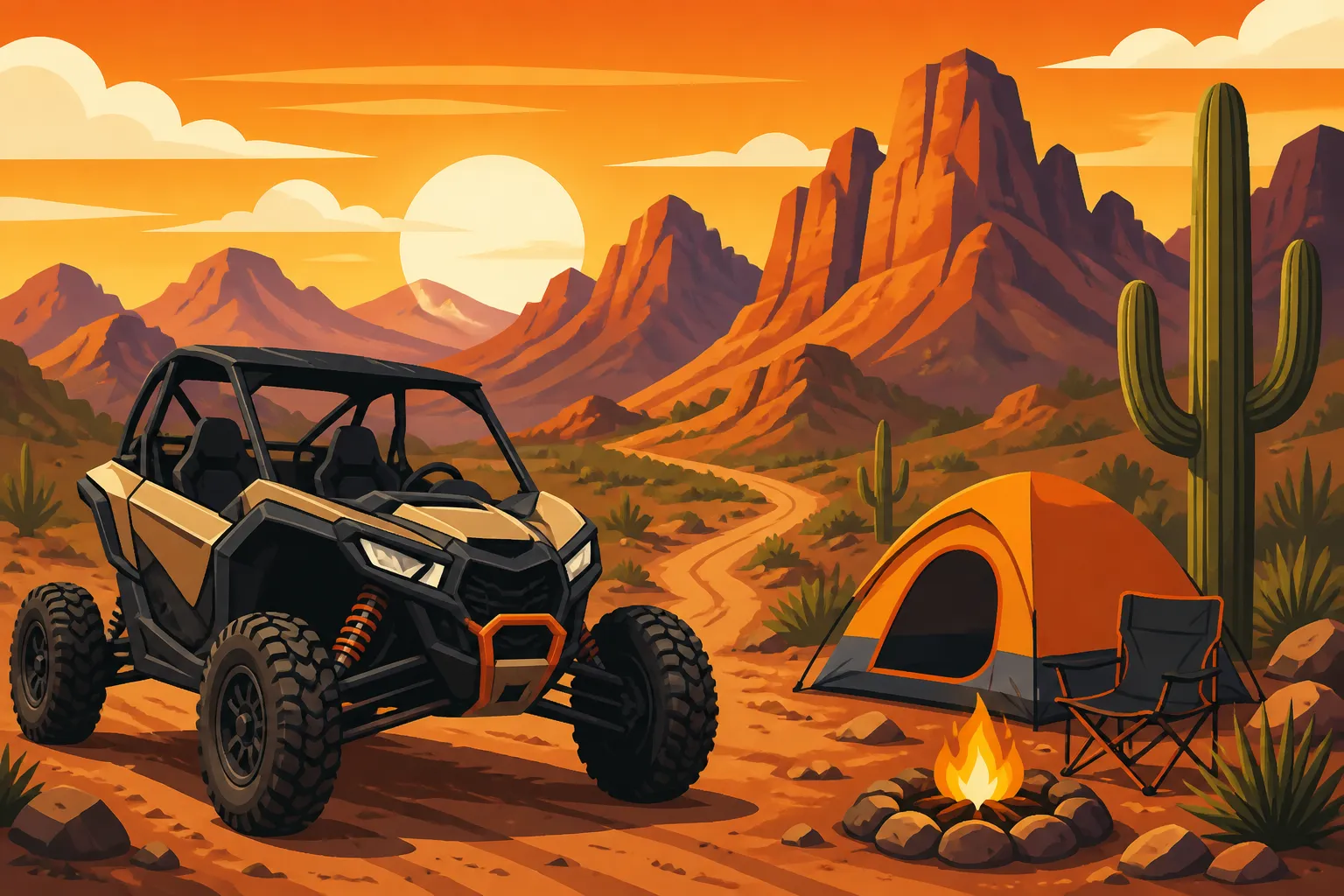
A campsite near a trailhead can save time, but it should not block a route, occupy a staging area, or create a hazard for other visitors. Look for an established, durable place where camping is permitted, and keep your tow vehicle, trailer, and side-by-side within the area that is already disturbed. Avoid widening a pullout by driving over vegetation or creating a new track to reach a more scenic spot.
The same principle applies when parking a trailer. A trailer can take up much more room than a passenger car, especially on narrow forest roads or at a small desert staging area. Before towing in, check whether the approach has tight turns, soft sand, steep grades, or a turnaround large enough for your rig. A site that is easy to reach in a pickup may be difficult to exit with a long trailer.
Plan to keep the camp orderly and contained. Park machines so they can be loaded or unloaded without blocking the road, and avoid leaving fuel, gear, or tie-down straps spread across a travel lane. If the trailhead is busy, it may be wiser to camp farther away at a lawful site and drive to the staging area in the morning. The planning guide [Arizona Trailhead Parking and Staging] offers a useful way to think about the difference between overnight camping space and daytime staging space.
Match the site to your rig and riding plans
A compact camper and a truck with a small ATV trailer may fit where a large toy hauler cannot. Before committing to a destination, think through the entire approach: road surface, grade, width, clearance, and space to turn around. A rough track can become much harder after rain, and soft desert sand can make a heavily loaded vehicle difficult to maneuver. Do not follow a narrow route simply because a map shows it continuing.
Also consider how close you truly need to be to the trail. Camping right beside a popular route can mean engine noise, dust, headlights, and other riders moving through early in the morning. A quieter camp a short drive away may be more comfortable and may reduce conflicts with other visitors. If you are riding with children or newer operators, a less crowded staging area can also make unloading and safety checks less stressful.
Use a map to compare potential access roads, but confirm conditions through land-manager notices and signs. Tools such as onX Offroad can help you review route context and land boundaries while planning, especially when a road network becomes confusing. Still, map layers cannot replace posted closures or an agency’s latest information. For broader trip preparation, [Planning an Arizona Riding Trip] can help you coordinate the campsite, trailer, and riding day.
| Planning question | Why it matters | What to confirm |
|---|---|---|
| Who manages the campsite? | Rules differ across federal, state, tribal, and private land | Land ownership and the agency or authority responsible |
| Is camping allowed at that exact spot? | A nearby trail or open road does not guarantee camping permission | Current camping rules, signs, and any local restrictions |
| Can your rig reach and turn around? | Narrow, sandy, or steep roads can be difficult with a trailer | Road conditions, clearance, width, and a safe exit |
| Is the ride route open to your machine? | Campsite access and OHV access are separate questions | Current route status, vehicle restrictions, and closures |
| Are fires allowed? | Restrictions can change with conditions and location | Current fire orders and rules for the specific land |
| Is there a water source? | Desert camps may have no reliable water nearby | Your own water supply and a realistic ride-day reserve |
Plan for Arizona’s terrain, weather, and limited services
Do not count on water, shade, or cell coverage
A dispersed campsite near a desert trailhead may have no potable water, restrooms, trash service, or shade. Bring enough drinking water for camp and the ride, and do not assume a tank, spigot, stream, or nearby business will be available when you arrive. In hot, exposed areas, water needs can rise quickly with exertion, sun, and time spent outdoors. Plan a reserve rather than packing only what you expect to drink on an ideal day.
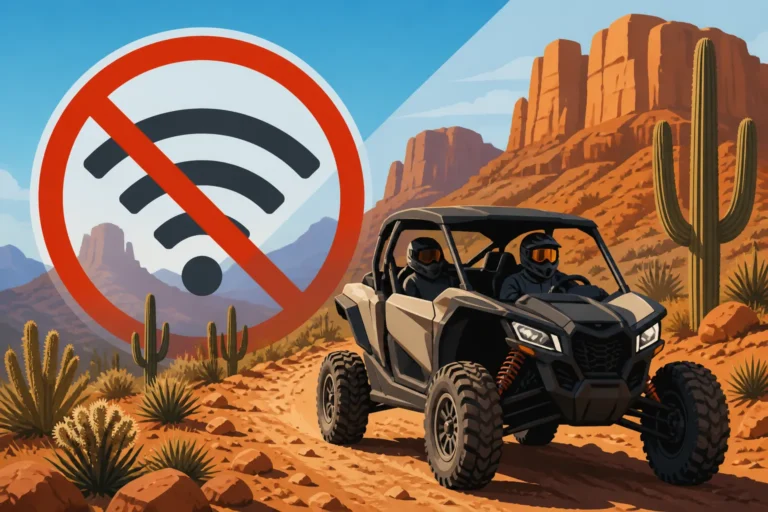
The same goes for communication. Cell service can disappear behind hills, in canyons, or well before you reach the trailhead. Tell someone where you intend to camp and when you expect to check in. Carry offline maps and know how to use them before leaving pavement. If the trip takes you far from regular service, consider a satellite communication device appropriate for your group and route.
onX Offroad can be useful for reviewing route options and saving map information for offline reference, but prepare before you lose reception. Download or save what you need while you have a reliable connection, and carry a backup navigation plan. A phone battery can drain faster in heat or when it is constantly searching for service. Read [Cell Service in the Arizona Backcountry] and [Water Planning for an Arizona Trail Day] before treating a remote camp as a simple overnight stop.
Take heat, monsoon weather, and fire rules seriously
Arizona conditions can change dramatically with elevation and season. A camp near Phoenix may be hot and exposed while a higher-elevation destination around Flagstaff or the Mogollon Rim feels much cooler at night. Summer afternoons can bring dangerous heat in low-desert areas, while monsoon storms may produce lightning, strong winds, and fast-moving water. A dry wash near camp is not a safe place to park or sleep if storms are possible upstream.
Check the forecast for the area you will actually visit, not just the nearest city. If storms are expected, reconsider routes that cross washes or narrow canyons, and do not drive through flowing floodwater. A sunny campsite can still be affected by rain miles away. For a closer look at this hazard, see [Flash Flooding in a Desert Wash].
Fire rules deserve a separate check every time. Restrictions may depend on the land manager and can change with weather and fire danger. Do not assume that a previously used fire ring means a fire is allowed today. Check the current order for your destination, follow any limits on camp stoves or equipment, and extinguish any permitted fire completely before leaving. The guide to [Arizona Fire Restrictions by Stage] explains why checking the current stage and local notices matters.
Set up camp with care and keep the riding area usable
Minimize your impact at the campsite
Dispersed camping works best when visitors leave a site looking much as they found it. Use an established, durable surface rather than driving into plants or creating a new access track. Keep vehicles and trailers within the existing disturbed area, and avoid digging trenches, moving rocks, or cutting branches to make a spot more convenient. A small shortcut can become a lasting scar when repeated by many visitors.
Pack out everything you bring in, including food scraps, packaging, broken gear, and trash left by someone before you. Do not leave waste beside a fire ring or hide it under rocks. If there are no restrooms, follow the land manager’s human-waste requirements and bring the supplies needed to comply. Do not assume burying waste is acceptable everywhere; rules and environmental conditions vary.
Noise and light also affect the experience of other campers and nearby residents. Keep engines off when you are not actively preparing to ride, avoid unnecessary revving, and use lights thoughtfully after dark. A group can be excited to get an early start without warming engines for a long time beside another campsite. Leave enough room for other visitors to pass, park, and use the trailhead safely.
Make your camp a safe base for the ride
Before unloading, identify where people will walk, where the machines will be parked, and how vehicles will exit. Keep children away from moving machines, tie-downs, and trailer ramps, and use a clear routine for loading and unloading. A busy trailhead is not a good place to make last-minute decisions about who is driving, where the keys are, or which gear belongs on each machine.
Secure food, fuel, tools, and riding equipment. Desert winds can scatter light items, and wildlife may be attracted to food left out. Store fuel according to the container’s instructions and keep it away from flames, heat sources, and places where a vehicle could strike it. Check each machine before setting out, including tires, lights, brakes, and essential recovery gear.
Give the group a simple plan for the day: intended route, expected return time, turnaround point, and what to do if the group becomes separated. Keep the plan realistic. A route that looks short on a map can take longer when the surface is rocky, sandy, or rutted. Check whether the route has recently closed or changed before leaving camp; [Checking Arizona Trail Status Before You Drive] is a useful part of that routine.
Avoid common mistakes before you leave home
Do not rely on an old map or a familiar-looking spot
A campsite that worked on a previous trip may no longer be available. A gate may close, a road may be washed out, an area may have a temporary restriction, or a land boundary may be less obvious than it appeared from the road. Familiarity helps, but it does not replace checking current information. Look for recent agency notices and obey signs on the ground, even if they conflict with an old route file or a friend’s directions.
When using a digital map, distinguish between a route being visible and a route being open. A line on a screen may represent a road, trail, or historic track that is not currently open to your vehicle. onX Offroad can help you compare route context and plan alternatives, but verify access with the responsible land manager. Save a legal backup route and a backup campsite before leaving reliable service.
Do not improvise across private property or closed land because a gate or fence looks easy to pass. If your planned route is blocked, turn around and reassess rather than creating a new track. Keep a record of the land manager’s contact information and the location of your intended camp. That makes it easier to resolve uncertainty before you arrive at a remote road junction.
Have a backup plan for access, weather, and crowded sites
Popular Arizona riding areas can be busy, especially during pleasant-weather weekends and holiday periods. A trailhead may have limited parking, and a nearby informal campsite may already be occupied. Do not assume that arriving late will leave a suitable place for a large trailer. Identify a second legal camping option and know how to reach it without crossing restricted land.
Weather can also change the plan. If a road becomes muddy, flooded, or unsafe for your trailer, do not force your way through to preserve the original itinerary. If heat becomes excessive or a rider is unwell, shorten the ride and return to camp. A flexible plan is not a failed trip; it is often the difference between a tiring day and a dangerous one.
Before departing, run through a final checklist:
- Confirm the land manager and camping rules for the exact campsite.
- Verify that your planned riding routes are open to your machine.
- Check weather, fire restrictions, and any temporary closures.
- Save offline maps and share your itinerary with someone at home.
- Pack drinking water, food, first-aid supplies, recovery gear, and tools.
- Identify a backup campsite and a safe route back to pavement.
- Leave the site clean, secure your load, and tell your contact when you return.
Dispersed camping can make an Arizona riding trip feel wonderfully simple: wake up near the route, check the machines, and head out before the day gets hot. The best trips are built on a little careful homework, though. Confirm access, respect the land manager’s rules, bring what the desert does not provide, and keep a backup plan ready if conditions change.
Disclaimer
This article is for general informational purposes only and does not constitute professional advice. Laws, prices and regulations vary by location and change over time. Consult a qualified professional for guidance on your specific situation.