Stopping Where a Road Crosses an Arizona Trail
A trail can run straight into a busy Arizona road with little warning, especially where desert washes, forest roads, and paved routes meet. Knowing when to stop, where to wait, and how to cross helps prevent collisions and keeps you from blocking traffic or surprising other riders. This guide explains a cautious, practical approach to road-and-trail crossings.
Why stopping at an Arizona trail crossing matters
A trail crossing is not automatically a safe crossing
A marked OHV route does not guarantee that traffic on the road will stop, slow down, or expect riders. A driver may be watching for cars and trucks, not an ATV or side-by-side emerging from a dusty two-track. On roads near trailheads, work sites, or small desert communities, vehicles can also approach faster than the terrain makes them seem.
Visibility can change in seconds. A berm, brush, a curve, a parked trailer, or a dip in the road may block your view of approaching traffic. Dust from another vehicle can make it difficult to judge how close a truck is, while bright Arizona sun can wash out a rider’s view when looking toward the west in late afternoon. Stopping before the road gives you time to look, listen, and decide whether the crossing is clear.
Stopping also protects the people behind you. If the lead rider pauses at the edge of a road, the rest of the group has a chance to slow down before reaching the crossing. If the leader charges ahead, riders farther back may follow without seeing traffic or understanding that the route has reached a road.
Check the route and road rules before you ride
A line on a map is not permission to ride on every road it appears to touch. Some routes allow OHVs to cross a road at a designated point; others may be closed, restricted, or subject to local rules. Before setting out, check the route information and posted signs, and do not assume that a crossing shown in an old map or GPS file is still open.
The rules can also depend on the road, the location, and how the machine is registered. An OHV that is not street legal generally cannot simply travel along a public road because it has reached a trail crossing. Street-legal requirements, local access rules, and signs still matter. For background on route access and riding restrictions, see [Which Arizona Roads Allow OHVs] and [Arizona Roads Closed to Off-Highway Vehicles].
If you are uncertain whether a route crosses a road legally, turn around or choose a confirmed route rather than improvising. A short detour is frustrating; an unsafe or prohibited crossing can be much worse. Riders planning a town-to-trail connection can also review [Riding Town to Trailhead in Arizona] before heading out.
Where and how to stop before crossing
Pause before the road edge, not in the traffic lane
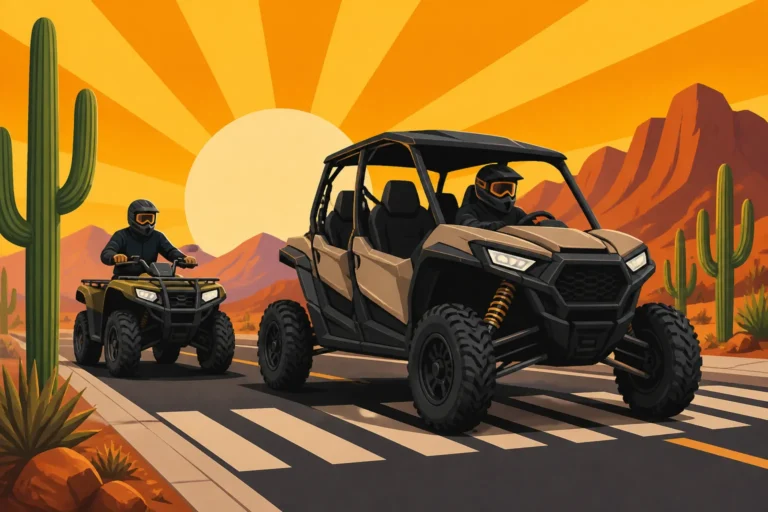
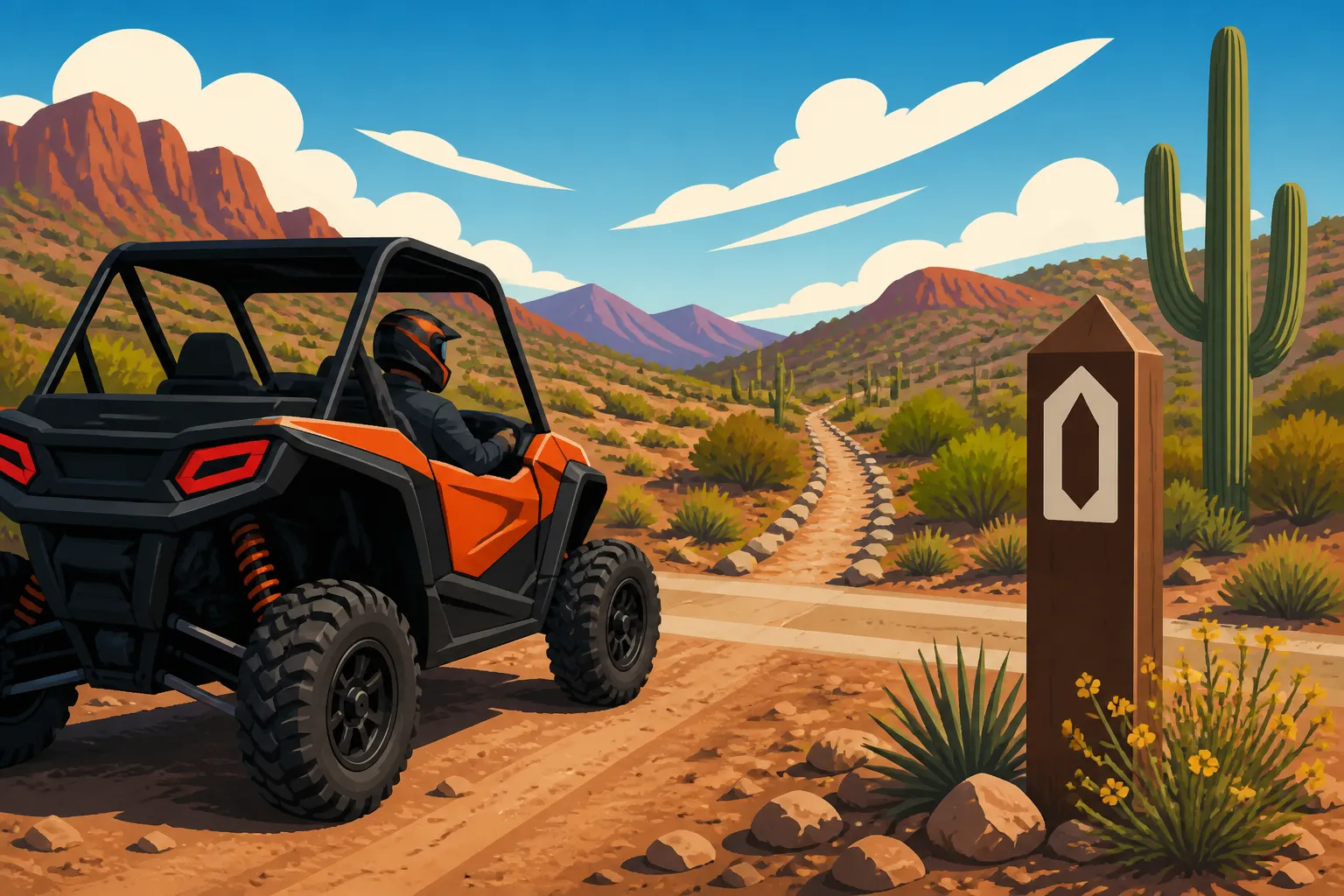
Approach slowly enough that you can stop before reaching the road. Pick a place with firm ground and a clear view, while staying out of the traveled lane and away from the path of vehicles. Do not stop with the front of your machine protruding into traffic, and avoid blocking a driveway, gate, or the trail entrance for other users.
The best stopping point is not always the closest patch of ground to the pavement. Loose gravel can make a heavy UTV slide when braking, while soft sand can make an ATV’s front wheels wander. If the trail slopes toward the road, reduce speed early and stop on stable ground before the slope carries you too close to traffic.
Give the group room to stop as well. Leave enough space between machines that a rider behind you is not forced into a sudden brake or a pile-up. If you are leading, use a clear hand signal or verbal cue when safe to do so. A rider who does not see the lead machine stop should not be allowed to roll straight into the crossing.
Stop, look, listen, and communicate
Once stopped, check both directions and look more than once. A single glance is not enough if the road bends, traffic is partly hidden, or dust limits visibility. Listen for engines approaching from behind a rise or around a curve, but do not rely on sound alone—wind, helmets, and engine noise can make a vehicle hard to hear.
Before crossing, make sure every rider knows the plan. A group should cross in a controlled way, with each operator making sure the route is clear rather than assuming the person ahead has checked for everyone. Do not crowd the road while waiting. If a vehicle approaches, stay put and let it pass; a driver’s wave does not make a crossing safe if you still cannot see traffic coming from the other direction.
Use mirrors to keep track of vehicles behind you and to notice traffic approaching while you are waiting. If you add aftermarket mirrors or lighting, confirm that they fit your machine and do not interfere with safe operation. SuperATV is one example of a brand riders may encounter when researching UTV visibility accessories; equipment can help you see or be seen, but it never replaces stopping and checking. For road equipment rules, see [Mirror Placement on a Street-Legal UTV] and [Arizona Headlight Rules for Night Riding].
| Crossing situation | Safer response |
|---|---|
| You cannot see far enough in both directions | Wait, move to a safer viewing position off the road, or turn back |
| Dust obscures approaching traffic | Stay stopped until visibility improves and the road is clearly open |
| A vehicle is approaching | Let it pass; do not rely on a wave as proof the road is clear |
| The group is spread out | Pause where riders can regroup safely without blocking the road |
| Signs or route markings are unclear | Do not assume the crossing is permitted; verify the route or choose another |
| The machine is not street legal | Do not ride along the public road to reach the next trail section |
Crossing as a group and handling difficult conditions
Keep the crossing orderly
A group crossing can become confusing when several machines arrive together. Riders may be eager to stay close, especially after a long stretch of trail, but rushing creates avoidable risks. Choose a leader who can assess the crossing and communicate clearly. Riders should cross only when they have their own clear view and enough room on the far side to get completely off the road.
Avoid stopping midway to wait for the rest of the group unless an emergency makes it necessary. Before moving, confirm there is space beyond the road for your machine to clear the traffic area without stopping. A narrow shoulder, steep bank, or another trail user waiting on the opposite side may leave less room than expected.
If the group cannot cross together safely, let it break into smaller, controlled crossings. The riders who have crossed should wait well away from the road, not directly at its edge. The last person through should check that no rider or passenger has been left behind, then rejoin the group at a safe staging spot.
For machines with road equipment, do not assume that being street legal changes the need for caution. A street-legal setup may permit certain road use, but the operator still needs to follow applicable traffic controls and local access rules. [What Arizona Requires on a Street-Legal Machine] and [Getting an MC Plate for a Side-by-Side] explain why road equipment and registration are separate from trail-crossing judgment.
Adapt to dust, darkness, heat, and road users
Dust is a frequent visibility problem on Arizona routes. If another vehicle has stirred up a cloud, do not follow it blindly across the road. Wait until you can see clearly in both directions. A brief pause is safer than guessing whether an approaching vehicle is hidden in the haze. Reflective gear, clean lights, and a visible machine can help other road users notice you, but they cannot make an obscured crossing safe.
At dusk or after dark, be more conservative. Headlights may help you see, but they do not guarantee that drivers can judge your distance or speed. Make sure required lights are working before the ride, and avoid crossing when glare, darkness, or a dusty windshield makes it hard to see traffic. SuperATV is also a name riders may see when comparing aftermarket lighting options; check that any equipment suits the machine and intended use, and confirm applicable requirements before riding on a road.
Watch for more than passenger vehicles. Arizona back roads may carry pickup trucks, trailers, delivery vehicles, ranch equipment, or larger work trucks. A loaded vehicle may need more space to stop, and its driver may have a limited view near the road edge. Give it room and wait rather than assuming it can brake quickly. In hot conditions, stay attentive even when the group is tired or eager to reach camp; fatigue and dehydration can slow decision-making. [Arizona Road Rules Riders Get Wrong] and [Water Planning for an Arizona Trail Day] cover other common factors that can affect safe riding.
Common crossing mistakes and a safer routine
Mistakes that make a crossing riskier
One common mistake is treating a trail junction as a traffic stop without checking whether the route actually permits the crossing. Another is stopping too late, with the machine partly on the pavement or positioned where an approaching driver cannot react comfortably. Dust and poor sightlines make both mistakes more dangerous.
Riders also sometimes assume the lead machine has checked the road for the entire group. That assumption can fail when the group is stretched out, when a rider is using a different line, or when the leader has a better view than the people behind. Each operator is responsible for making a safe decision for their own machine and passengers.
Finally, do not use a road crossing as a place to sort out maps, adjust gear, or wait for someone to catch up. Those tasks are better handled at a designated pullout or other safe area away from traffic. If you need to regroup, move fully clear of the road and trail entrance before stopping for longer.
A practical routine to follow
Use the same simple routine at every crossing, even on a road you know well:
- Slow early. Reduce speed while you still have room to stop on stable ground.
- Read the signs. Check for closure notices, access restrictions, traffic controls, and route markings.
- Stop before the road. Keep the machine and any trailer clear of the traveled lane.
- Look and listen both ways. Check again if the view is blocked or dust is moving across the road.
- Make a clear group plan. Ensure each rider knows who is crossing and where the group will regroup.
- Cross only when there is room. Do not enter unless you can clear the road safely and reach a secure spot beyond it.
- Regroup away from traffic. Wait for others off the road, not at the pavement edge.
The routine should not become automatic in the sense of careless repetition. Road conditions, traffic, visibility, and access rules can change from one crossing to the next. A familiar route can still have a new hazard: a vehicle stopped beyond a curve, fresh washout, drifting sand, or a changed sign. If the crossing does not look clearly safe and permitted, stop and reassess.
For broader planning, [Reading an Arizona Motor Vehicle Use Map] can help riders understand designated routes, while [Arizona Trailhead Parking and Staging] is useful when deciding where to regroup before or after a ride. Keeping access, visibility, and group spacing in mind makes road crossings calmer—and gives everyone a better chance of finishing the ride without a close call.
Disclaimer
This article is for general informational purposes only and does not constitute professional advice. Laws, prices and regulations vary by location and change over time. Consult a qualified professional for guidance on your specific situation.