Driver’s License Rules for Arizona Road Riding
Navigating the open roads in your beloved ATV or UTV can feel like the ultimate freedom here in Arizona, especially when you’re trying to connect trails or grab a bite in a small desert town. But that dream can quickly turn into a headache, or worse, a costly citation, if you're unclear on the rules, especially when it comes to who can actually be behind the wheel. This guide is here to clear up all the confusion around driver's license requirements for operating street-legal off-highway vehicles on Arizona's public roads, helping you ride confidently and legally.
Understanding Arizona's Street-Legal OHV Landscape
Arizona's vast and diverse terrain makes it a paradise for OHV enthusiasts, offering everything from winding desert trails to high-country forest roads. However, the moment your tires leave the dirt and touch pavement, a whole new set of regulations comes into play. It's not just about having the right accessories; it's about operating your machine within the framework of state motor vehicle laws, and that starts with understanding what a "street-legal" OHV truly means in our state.
What Makes an OHV "Street Legal" in Arizona?
The desire to make an OHV street-legal often stems from a simple, understandable frustration: you want to get from your camp to a trailhead without having to load up your machine, or maybe you want to cruise into a small town like Quartzsite or Wickenburg for some supplies. This convenience is incredibly appealing, and thankfully, Arizona allows it, provided your machine meets specific criteria to be registered as a street-legal vehicle. This isn't just a simple sticker you buy; it's a comprehensive modification and registration process. Your ATV or UTV needs to be equipped with all the safety features typically found on a standard passenger car. We're talking about functional headlights and taillights, turn signals, brake lights, a horn that's audible from a good distance, at least one mirror (though two are always better for visibility), and a license plate light. Without these, your machine is simply not eligible for street-legal registration, and you definitely won't be cruising down Main Street anytime soon. It's a commitment, but for many, the freedom it offers is well worth the effort.
The Distinction Between Off-Road and On-Road Rules
It’s easy to get these rules mixed up, especially since many of us are used to the less stringent requirements of pure off-road riding. When you're out on a designated OHV trail, the primary concerns are often about having a valid [Arizona's Annual OHV Decal Explained], wearing proper safety gear like helmets (especially for younger riders), and respecting land closures. Your focus is on the adventure, the terrain, and the camaraderie of the trail. However, the instant your wheels hit any public road, whether it's a paved county road or a city street, your machine transforms, legally speaking, into a bona fide motor vehicle. This means it's suddenly subject to the same traffic laws as cars, trucks, and motorcycles. This is where the common misunderstandings crop up. Many riders assume that because their machine can go fast or looks like a car, they can treat it as such without fully grasping the legal obligations. The leap from dirt to asphalt isn't just physical; it's a significant legal shift that brings with it responsibilities like having a valid driver's license, proper registration, and insurance.
The Core Rule: Driver's License Requirements for Street-Legal OHVs
This is often the first question on every rider's mind when they think about taking their OHV on the pavement: "Do I need a driver's license?" The short answer, for Arizona's public roads, is a resounding yes. It's a critical piece of the puzzle that often surprises new riders or those transitioning from solely off-road adventures.
Standard Arizona Driver's License for OHV Operators
The truth is quite straightforward: if you want to operate a street-legal ATV or UTV on any public road in Arizona, you need a valid Arizona driver's license. It’s that simple. There's no special OHV endorsement you need to add to your license, no extra test you have to take that's specific to side-by-sides or quads. If you can legally drive a car or truck on Arizona roads, you can legally drive a street-legal OHV. This means your license must be current, not expired, and not suspended or revoked for any reason. If you've ever had the unfortunate experience of being pulled over and realized your license had expired last week, you know the kind of trouble this can cause. The same goes for your street-legal OHV. Treat it as you would any other vehicle when it comes to carrying and presenting your driver's license. This rule ensures that anyone operating a motor vehicle on public thoroughfares has demonstrated a basic level of driving competence and knowledge of traffic laws, which is crucial for everyone's safety, whether they're in a sedan or a heavily modified UTV.
Exceptions and Special Cases
While the rule about needing a valid driver's license is pretty firm, people often wonder about specific situations. What if you're visiting from out of state? Good news there: Arizona generally recognizes valid driver's licenses issued by other U.S. states and even foreign countries, as long as you're not an Arizona resident. So, if you're a snowbird from Michigan or a vacationer from California with a valid license from your home state, you're usually good to go on a street-legal OHV here. However, what about instruction permits? This is where it gets a little trickier, and we'll delve deeper into it later, but generally, if an instruction permit allows you to operate a regular motor vehicle under supervision, it would extend to a street-legal OHV. The key is under supervision. There are no broad agricultural exemptions that allow unlicensed operators to drive an OHV on a public road for farm work; those exemptions typically apply to specific types of farm equipment and very limited road crossings, not general OHV use. So, while a farmer might have an exemption for a tractor, their UTV, even if used for ranch work, still falls under standard driver's license rules when hitting the pavement.
Age, Permits, and Younger Riders on Arizona Roads
One of the biggest areas of confusion, and frankly, a source of parental concern, revolves around how Arizona’s age restrictions for OHV operation intersect with the rules for driving on public roads. Many parents are familiar with the off-road rules that allow younger riders on smaller machines, but the game changes entirely when pavement is involved.
Minimum Age for Operating a Street-Legal OHV on Roads
Here’s the straight truth that can sometimes be a letdown for younger enthusiasts: if your ATV or UTV is street-legal and you want to drive it on an Arizona public road, you must be at least 16 years old and possess a valid Arizona driver's license. This isn't an OHV rule; it's a fundamental Arizona motor vehicle law. Since you can't get an unrestricted driver's license in Arizona before turning 16, this automatically sets the minimum age for operating any street-legal vehicle, including an OHV, on public roads. This stands in stark contrast to the rules for off-road riding, where riders as young as 10 or 12 can operate certain machines on trails, often under adult supervision. That distinction is crucial. You might see a confident 14-year-old tearing it up on a desert trail in their quad, but that same rider cannot legally operate a street-legal side-by-side on even the quietest residential street. The reason is simple: the inherent risks of mixing with general traffic and the need for demonstrated driving competence.
The Role of Instruction Permits and Supervised Driving
So, what about those eager 15-year-olds who have their instruction permit? Can they drive a street-legal OHV on the road with a licensed adult? Yes, typically they can, but with the same strict conditions that apply to driving any other motor vehicle with a permit. This means the permit holder must have a licensed driver who is at least 21 years old sitting next to them in the passenger seat. This supervising driver must hold a valid driver's license. For a side-by-side, this arrangement is usually quite feasible; the supervisor can sit right beside the permit holder, just like in a car. However, the practicality for an ATV is a different story, as ATVs are generally designed for a single operator. This makes it impossible for an instruction permit holder to legally operate an ATV on the road, as there's no way for the supervising driver to be "next to them." It’s these practical challenges that often limit the road use of street-legal ATVs by those holding only instruction permits, reinforcing that a full, unrestricted driver's license is almost always the prerequisite for solo road adventures.
What to Carry and Expect When Pulled Over
Nobody wants to get pulled over, especially when you're just trying to enjoy a ride. But it happens, and being prepared can make all the difference between a quick interaction and a prolonged hassle. Knowing what documents you need and how to interact with law enforcement is key for any street-legal OHV operator.
Required Documents While Operating on Roads
Just like driving your car to the grocery store, when you're operating a street-legal OHV on Arizona's public roads, you need to have specific documents with you. First and foremost, you absolutely must carry your valid driver's license. This is non-negotiable. Beyond that, you'll need the vehicle's registration, which proves that your machine is properly documented with the Arizona Motor Vehicle Division (MVD) and eligible for road use (meaning it has an MC or RV plate, not just an OHV decal). Lastly, you need proof of financial responsibility, or in plain terms, your insurance card. Arizona is not a no-fault state, and minimum liability insurance is mandatory for all registered motor vehicles, including your street-legal OHV. It's a good idea to keep these documents organized and easily accessible, perhaps in a waterproof bag or a designated compartment on your machine. Fumbling around for five minutes in your backpack while a deputy waits can be frustrating for everyone involved. Think about it: if you were driving your truck, you'd have these papers ready. The same applies to your side-by-side. For more tips on keeping your papers safe and sound, check out [Keeping the Paperwork on the Machine].
Common Scenarios and Deputy Interactions
It's natural to feel a bit of anxiety when you see those flashing lights in your rearview mirror, but remember, deputies are primarily concerned with safety and compliance. When a law enforcement officer pulls you over, they're generally looking to ensure your machine is street-legal, properly registered, and that you are a licensed, insured operator. They'll likely ask for your driver's license, registration, and proof of insurance, just as they would with any other vehicle. They might also check your equipment, like lights or mirrors, to ensure they're all functional. The best approach is always to be courteous, cooperative, and honest. Keep your hands visible, turn off your engine, and don't make any sudden movements. If you don't have a valid driver's license or any of the other required documents, it can lead to citations, and in some cases, your machine might even be impounded. An officer isn't usually trying to ruin your day, but they are enforcing the law. Understanding [What an Arizona Ranger Asks a Rider For] can help you anticipate their questions and respond appropriately, making the encounter as smooth as possible.
Insurance and Other Prerequisites for Road Use
Beyond the driver's license itself, there are other crucial requirements that transform your off-road toy into a road-worthy vehicle. Neglecting these can be just as problematic as driving without a license, leading to fines, legal issues, and leaving you exposed financially in case of an accident.
Mandatory Insurance for Street-Legal OHVs
This is a point many OHV owners overlook: once your machine is designated as street-legal and registered for public road use in Arizona, it must carry minimum liability insurance. This isn't optional, it's the law, just like with your car or truck. The reason is simple: if you're involved in an accident on a public road, you're responsible for any damages or injuries you cause to others. That minimum coverage typically includes bodily injury liability and property damage liability, often expressed as 25/50/15 – $25,000 for injury or death of one person, $50,000 for injury or death of two or more persons, and $15,000 for property damage. It's important to talk to your insurance provider because not all auto policies will automatically extend to your street-legal OHV. You might need a specific policy or an endorsement to your existing one. Many off-road policies only cover your machine while it's off-pavement or being transported, so make sure your coverage explicitly covers road riding. Reputable manufacturers of OHV parts like SuperATV might offer products that enhance safety features on your machine, but these physical upgrades don't replace the need for proper insurance coverage. You can learn more about the specific figures at [Arizona Insurance Minimums for Road Riding].
Registration and Plates Beyond the OHV Decal
Another common area of confusion is the interplay between the Arizona OHV decal and actual street-legal registration. While the OHV decal is absolutely necessary for riding off-road on public lands in Arizona, it does not make your machine street-legal. For that, your OHV needs to be fully titled and registered with the Arizona MVD as a motor vehicle, which means it will be issued a standard license plate, typically an "MC" plate for motorcycles or "RV" for recreational vehicles if it exceeds certain weight thresholds or is more car-like. [MC Plates and Street-Legal Machines] are common for many street-legal ATVs and smaller UTVs, while larger, heavier side-by-sides might fall under [RV Plates and Off-Highway Only Machines]. This street-legal registration requires your machine to meet all the equipment requirements (lights, mirrors, horn, etc.) and means you'll pay standard vehicle registration fees, not just the annual OHV decal fee. You'll still need the OHV decal if you plan to take your street-legal machine off-road, as it contributes to the OHV fund that maintains trails. Think of it this way: the street-legal plate allows you to operate on roads, and the OHV decal allows you to operate on designated off-highway trails. Both serve different, but often complementary, purposes for the avid Arizona rider.
Practical Implications and Common Pitfalls
Even with all the rules laid out, putting them into practice on the ground can sometimes lead to tricky situations or unforeseen complications. Understanding these practical implications and the common mistakes riders make can save you a lot of grief and ensure your adventures stay fun and legal.
Riding Town to Trailhead: The Reality
The dream scenario for many OHV owners is to simply jump in their street-legal machine, cruise from their home or campsite right to the trailhead, and then seamlessly transition to off-road riding. In reality, while this is perfectly legal with a street-legal machine and valid driver's license, it requires careful planning and adherence to all traffic laws. You can't just blast through town at off-road speeds or ignore stop signs because you're "on your way to the dirt." On city streets and county roads, your street-legal OHV is expected to behave exactly like any other vehicle. This means obeying speed limits, yielding right-of-way, signaling turns, and everything else a car driver would do. The temptation to "just get there" can lead to dangerous driving habits and attract unwanted attention from law enforcement. Remember that local communities often have their own ordinances regarding OHV use on city streets, so always check before assuming full access. This convenience, when enjoyed responsibly, is one of the biggest perks of having a street-legal setup, but it demands a heightened sense of road awareness. For more on navigating these transitions, see [Riding Town to Trailhead in Arizona].
Avoiding Common License-Related Violations
The most frequent license-related violation is, unsurprisingly, operating a street-legal OHV on a public road without a valid driver's license. This might be someone whose license is suspended, expired, or even a minor who mistakenly believes their off-road experience translates to road legality. Another common pitfall is letting an unlicensed minor, even a responsible one, take the wheel of a street-legal side-by-side on a county road. While they might be excellent off-road riders, the moment that machine hits the pavement, a full driver's license is required. Forgetting to carry your physical driver's license, even if it's valid, can also lead to a "failure to present" citation, which is an unnecessary headache. The consequences for these violations can range from significant fines to vehicle impoundment, and in more severe cases, could even impact your driving record or future insurance rates. It’s not worth the risk. Always double-check your wallet and your passenger's eligibility before venturing onto any public road. Familiarize yourself with [Arizona Penalties for Illegal Road Riding] to understand the potential repercussions.
Making Your Machine Road-Ready (Beyond the License)
Having your driver's license in hand is just one part of the equation. To truly embrace the freedom of street-legal OHV riding, your machine itself needs to be equipped and maintained to meet Arizona's strict standards for road use. It's about safety, compliance, and ensuring your machine is a responsible member of traffic.
Essential Street-Legal Equipment Overview
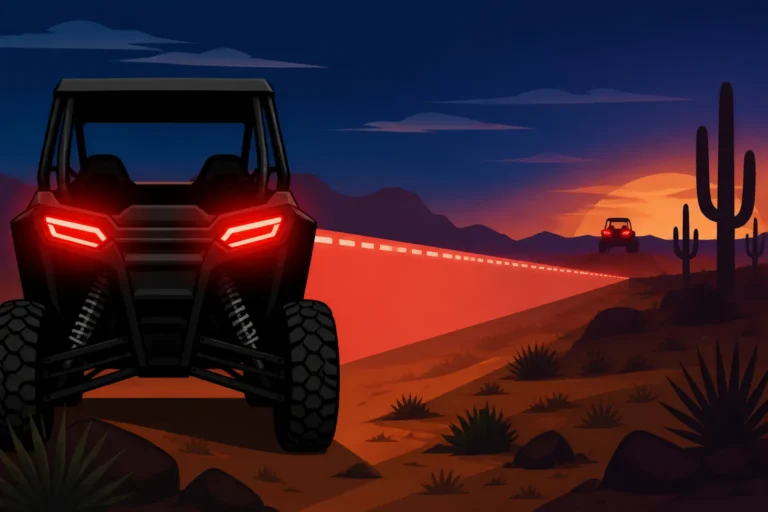
Making your OHV street-legal involves a series of mandatory modifications to ensure it meets the safety and visibility standards of any other vehicle on the road. These aren't just suggestions; they are legal requirements. Your machine needs functional headlights that can illuminate the road for at least 500 feet, which you can read more about in [Arizona's 500 Foot Headlight Rule]. Rear-facing taillights and brake lights, visible from 500 feet, are also critical; check out [Taillights and Rear Reflectors Arizona Requires]. You'll need turn signals on both the front and rear, a horn that's audible from at least 200 feet (see [The Horn Arizona Wants Audible at 200 Feet]), and at least one rearview mirror, although two are always recommended for better situational awareness. Some riders even add a windshield and wipers for comfort and safety. Many riders turn to aftermarket companies like SuperATV for high-quality components and kits that specifically help convert an off-road machine to street-legal status, from wiring harnesses for turn signals to robust mirrors that can handle the bumps of both trails and pavement. These modifications ensure that your OHV is visible to other drivers and that you can communicate your intentions safely on the road, contributing to overall traffic safety.
The Importance of a Roadworthy Machine
It's one thing to have the required equipment installed; it's another to ensure it's all in good working order. A street-legal OHV isn't just about legality, it's fundamentally about safety – for you, your passengers, and everyone else on the road. This means regularly inspecting your lights, checking your horn, and ensuring your mirrors are clean and properly adjusted. Tires are another critical component; while knobby off-road tires are great for traction in the dirt, they can wear quickly and handle differently on pavement, potentially affecting braking and cornering. Make sure your tire pressure is appropriate for road use, which might be higher than what you'd run off-road. Regular maintenance, such as checking fluid levels, brakes, and steering components, becomes even more important when your machine is sharing the road with heavier, faster-moving traffic. A mechanical failure on a trail might be an inconvenience, but a failure on a busy highway can be catastrophic. Investing in quality parts, like those offered by SuperATV, and keeping your machine meticulously maintained helps ensure it's not just legally compliant but truly roadworthy for every adventure you embark on.
Summary of Arizona Driver's License Rules for OHVs
To help clarify the various rules for different scenarios, here's a quick summary of when a driver's license is required for OHV operation in Arizona.
| Scenario | Driver's License Required? | Minimum Age (Generally) | Notes |
|---|---|---|---|
| Street-Legal OHV on Public Roads | YES | 16 | Must possess a valid, unexpired, non-suspended Arizona driver's license (or valid out-of-state license if non-resident). |
| Street-Legal OHV with Instruction Permit | YES (with conditions) | 15 years 7 months | Must be accompanied by a licensed driver 21+ years old in the passenger seat (practical for UTVs, not ATVs). |
| OHV (Off-Road Only) on Designated Trails | NO (for adults) | 16 (to operate solo) | Arizona's general off-road OHV rules require riders 18+ to have a valid driver's license or have completed the OHV safety course. Under 18, specific age/size rules apply. |
| OHV on Private Property (with permission) | NO | Any Age (with supervision) | Owner's rules apply. Local ordinances may still dictate age/safety gear. |
| Crossing a Public Road (OHV, non-street-legal) | NO | 16 (for permitted crossings) | Limited, direct crossings of roads are often allowed for non-street-legal OHVs, but driver must be 16+, have an OHV decal, and yield to traffic. |
This table highlights the crucial distinction between off-road and on-road operation when it comes to driver's license requirements.
Disclaimer
This article is for general informational purposes only and does not constitute professional advice. Laws, prices and regulations vary by location and change over time. Consult a qualified professional for guidance on your specific situation.