Supervising a Young Rider in the Desert
A young rider can be capable and still be unprepared for desert hazards that adults take for granted: loose sand, sharp rock, heat, dust and changing trail conditions. Good supervision is more than following behind. It means choosing a suitable machine and route, setting clear limits, and staying close enough to intervene before a small mistake becomes a serious problem.
Check the rules and set the ride limits
Before planning the route, confirm the current requirements that apply to the rider, machine and land. Arizona rules can depend on the rider’s age, whether the vehicle is an ATV or UTV, and whether the ride is on public, state or private land. Helmet, training, equipment and operating rules may differ by situation. Review [Arizona Age Rules for Young Riders], Arizona Education Rules for Under-18 Riders and Arizona Rules for Operators Under 12, then verify details with the relevant official agency if anything is unclear.
Pay particular attention to age-related limits on the machine itself. A young rider should not be placed on an ATV that is too large or powerful for their experience simply because they can reach the controls. Check Engine Size Limits for Arizona Riders Under 16 and the manufacturer’s guidance before choosing a machine. For a UTV, review the seating and passenger requirements, including whether the child can sit correctly and use the restraint system as intended.
A parent or supervising adult should also settle the ground rules before the engine starts. Be specific rather than relying on “be careful.” Agree on a maximum speed, following distance, stop signals, passing rules and what to do if the group separates. Explain that the young rider must stop when signaled, stay on the approved route and never attempt a hill, crossing or obstacle without permission.
Useful rules to agree on include:
- Keep the machine in sight of the supervising adult.
- Do not pass the lead adult or leave the group.
- Stop at every junction and wait for instructions.
- Do not race, ride side by side on a narrow trail or make sudden turns.
- Tell the adult immediately about a problem, even if it seems minor.
- Never follow another group onto a route the supervising adult has not approved.
Decide in advance what will end the ride. That might be fatigue, overheating, a mechanical issue, a change in weather, a missed turn or repeated disregard for instructions. A clear stop rule is easier to apply than negotiating after everyone is tired.
Rules for a child riding on private property may not be the same as rules for public land, and permission to ride on private ground does not automatically make a route safe. For land open to public use, check current access rules and trail restrictions. On state land, a permit may be needed for recreational access, and an OHV decal does not necessarily grant permission to stage or travel across every parcel. Arizona State Trust Land Recreational Permits explains why it is important to check both vehicle requirements and land access.
Match the machine, terrain and route to the rider
A good first desert ride is not a test of bravery. Choose a machine the young rider can control comfortably and a route with room to slow down, stop and regroup. Consider strength, reach, coordination, attention span and experience—not just age. The rider should be able to understand the controls, operate them smoothly and follow directions without constant reminders.
For an ATV, check that the rider can reach the handlebars and controls while maintaining a stable posture. They should be able to turn, brake and shift their weight without stretching or sliding around on the seat. For a UTV passenger, check that the child fits the seat and can use the seat belt or other restraint correctly. A helmet and restraint do not make an unsuitable passenger position safe.
| Decision | A better fit for a young rider | A reason to choose another option |
|---|---|---|
| Machine | Manageable power and controls the rider can operate comfortably | The rider struggles to brake, steer or reach controls |
| Route | Wide, visible and within the rider’s demonstrated ability | Tight turns, steep slopes, deep sand or exposed edges |
| Ride length | Short enough to finish before fatigue builds | Long distance, heat or few safe places to stop |
| Group size | Small enough for the adult to keep everyone in view | Dust, speed or spacing makes direct supervision difficult |
| Conditions | Clear visibility and a route checked before departure | Heat, storms, flooding, smoke or closures make travel uncertain |
Start with a route the adult knows or has checked using current information. Trail ratings are useful for planning, but they do not guarantee that a route is easy for every child or in every condition. A trail can become more challenging after rain, erosion, traffic or loose sand. Arizona Trail Difficulty Ratings can help frame the choice, while Family-Friendly Arizona OHV Trails can help identify options to assess. Verify current route access and conditions before driving to the trailhead.
Avoid choosing a route because it looks short on a map. A short stretch can still include a steep climb, a rough wash, a narrow ledge or a confusing intersection. Think about where the adult can stop safely, whether there are turnarounds and how the group would get help if a machine had a problem. For a first ride, a simple out-and-back route is often easier to supervise than a loop with unfamiliar junctions.
Build the route around the least experienced person. If adults in the group want a challenging detour, the young rider should not be expected to attempt it to keep up. Split the group only if there is a capable adult assigned to each part and the meeting point is clear. Otherwise, keep everyone on the route selected for the young rider.
Conditions matter as much as the map. Desert heat can turn a manageable outing into a stressful one, especially when a child is concentrating on steering and may not notice thirst or fatigue. Plan water, shade and rest stops before setting out. See Water Planning for an Arizona Trail Day and Heat Illness on a Summer Trail for practical preparation. If rain or a storm is possible, avoid routes that could trap the group in a wash or low crossing; do not assume a wash is safe because it is dry at the trailhead.
Supervise actively while riding
For an inexperienced young rider, the supervising adult should ride close enough to communicate and intervene, while leaving enough space to avoid a collision if the child brakes suddenly. There is no universal safe distance: terrain, dust, visibility, speed and vehicle type all matter. On a narrow trail, the adult may need to lead and have another experienced adult follow. On a route with clear sightlines, the supervising adult may be better positioned behind the young rider, where they can see how the rider handles the machine.
Choose the arrangement that gives the adult the best practical view and control. Do not let a young rider disappear around a bend or move so far ahead that instructions cannot be heard. If dust blocks visibility, slow down or stop until the group can see clearly. Riding faster to catch up usually makes the situation worse.
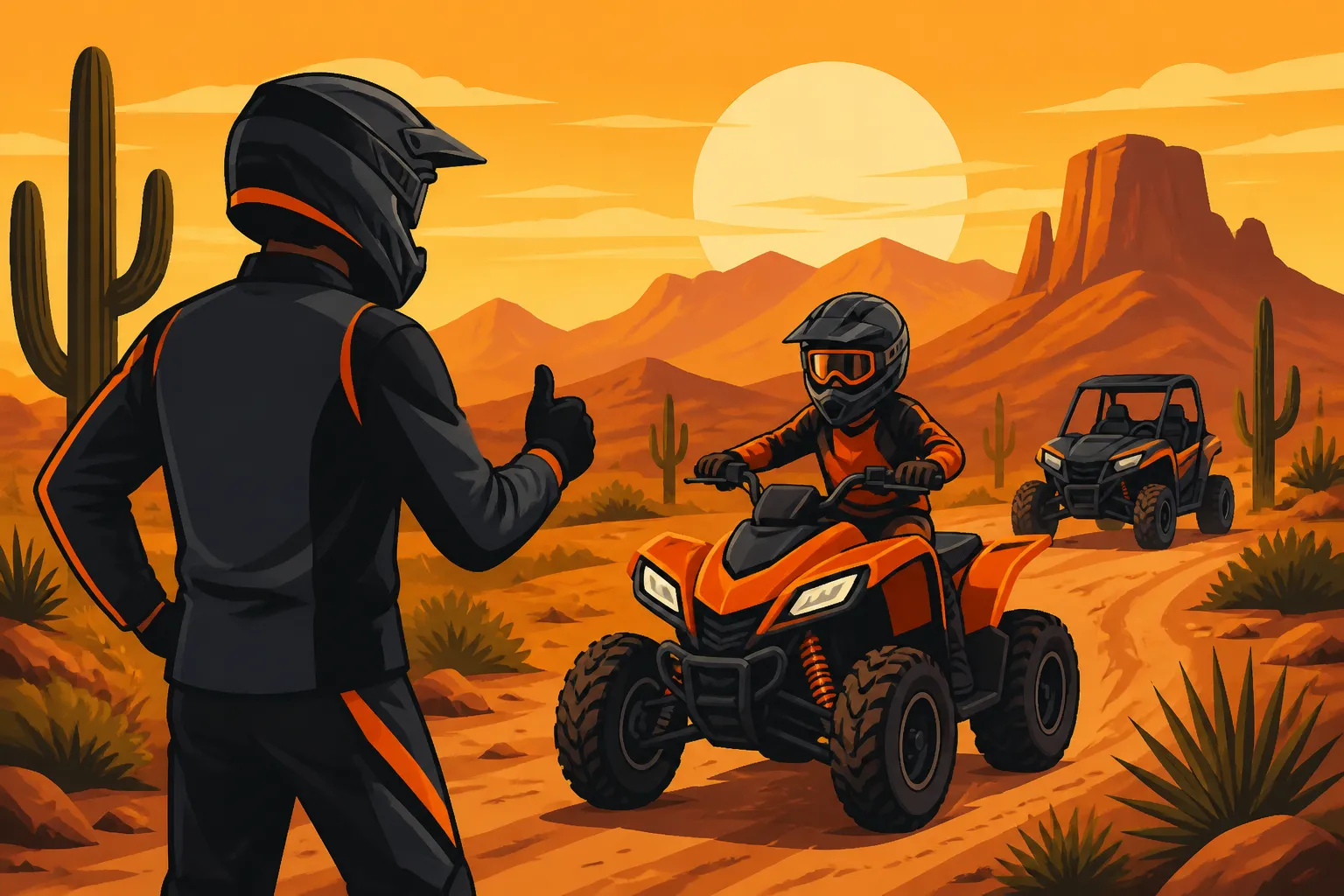
Set a predictable communication routine. Before leaving the staging area, choose simple hand signals or another method that works with helmets and engine noise. Explain what means “slow down,” “stop,” “come to me” and “wait here.” Make sure the child knows to pull over only where it is safe and visible, rather than stopping in the middle of a trail or around a blind corner.
At intersections, crossings and places where the route is unclear, stop the group and confirm everyone is together before moving on. One adult can lead across while another stays with the child if the group has enough responsible adults. Never assume a child can safely judge a road crossing or fast-moving traffic because they have ridden an easy trail.
Give instructions in short, calm phrases. A young rider who is nervous may not process a long explanation while moving. If the child makes a mistake, get everyone to a safe stopping place before discussing it. Correct the behavior clearly, then decide whether to continue. Repeated mistakes, panic, frustration or fatigue are reasons to pause or end the ride, not to push harder.
Watch for changes that the child may not mention:
- Slower reactions or difficulty following familiar instructions
- Repeatedly missing turns or drifting off the chosen line
- Trouble holding a steady pace or controlling the machine
- Irritability, unusual quietness, confusion or loss of coordination
- Complaints of headache, nausea, dizziness, weakness or feeling unusually hot
- A helmet or protective gear that has shifted or become uncomfortable
These signs can reflect fatigue, stress, heat or a mechanical issue. Stop in a safe place, check the rider and machine, and do not resume until the problem is understood. If symptoms suggest heat illness or another urgent medical problem, get the rider out of the heat and seek emergency help as appropriate.
At busy trailheads, dust and moving vehicles create additional risks. Keep young riders away from active unloading areas and moving trailers. Establish a meeting point and keep the child with an adult while the group checks equipment or discusses the route. Young Riders at a Busy Staging Area offers more on managing this part of the outing.
Prepare for problems and know when to turn back
Supervision starts before the ride. Inspect the machine, verify fuel and basic equipment, and make sure the child has a properly fitted helmet and suitable eye protection. Check that clothing covers exposed skin and that footwear is secure. On a UTV, confirm that the seat belt or restraint is adjusted correctly and that the child remains seated as intended. Equipment requirements can depend on location and rider age, so review Arizona Helmet Requirements on State Land rather than assuming one rule covers every ride.
Carry enough water for the planned outing and more if conditions or delays could increase the need. Bring a charged phone, but do not rely on cell service in remote areas. Tell someone who is not riding where you plan to go and when you expect to return. For a less familiar or remote route, consider additional communication and emergency equipment appropriate to the area.
Before leaving, inspect tires, brakes, steering, throttle and lights. Make sure the child knows to stop and tell an adult if the machine feels different, a warning light appears or anything comes loose. Do not let a minor issue become a reason to press on; a loose component or unreliable brake can change the risk quickly.
Use frequent, planned breaks. Children may keep riding to satisfy the group even when tired, so ask direct questions and look at how they are moving and responding. A break is also a chance to drink, check protective gear, review the next section and decide whether the conditions still suit the rider. If the young rider is a passenger in a UTV, check their comfort and restraint position rather than treating the seat belt as a substitute for attention.
Turn back if the route becomes harder than expected, visibility drops, weather changes, the rider becomes tired or the group can no longer stay together. Do not continue just because the trailhead is close or the planned destination is nearly reached. In the desert, the return trip can be more difficult than the outward leg, so make the decision while there is still time and energy to get back safely.
A successful ride is one where the child stays within their ability, follows the agreed rules and finishes feeling ready to ride again—not one where the group covers the most miles. Gradually add distance or difficulty only after the young rider consistently handles the current level. Keep the adult’s expectations ahead of the child’s wish to go faster, farther or try the next obstacle.
Disclaimer
This article is for general informational purposes only and does not constitute professional advice. Laws, prices and regulations vary by location and change over time. Consult a qualified professional for guidance on your specific situation.