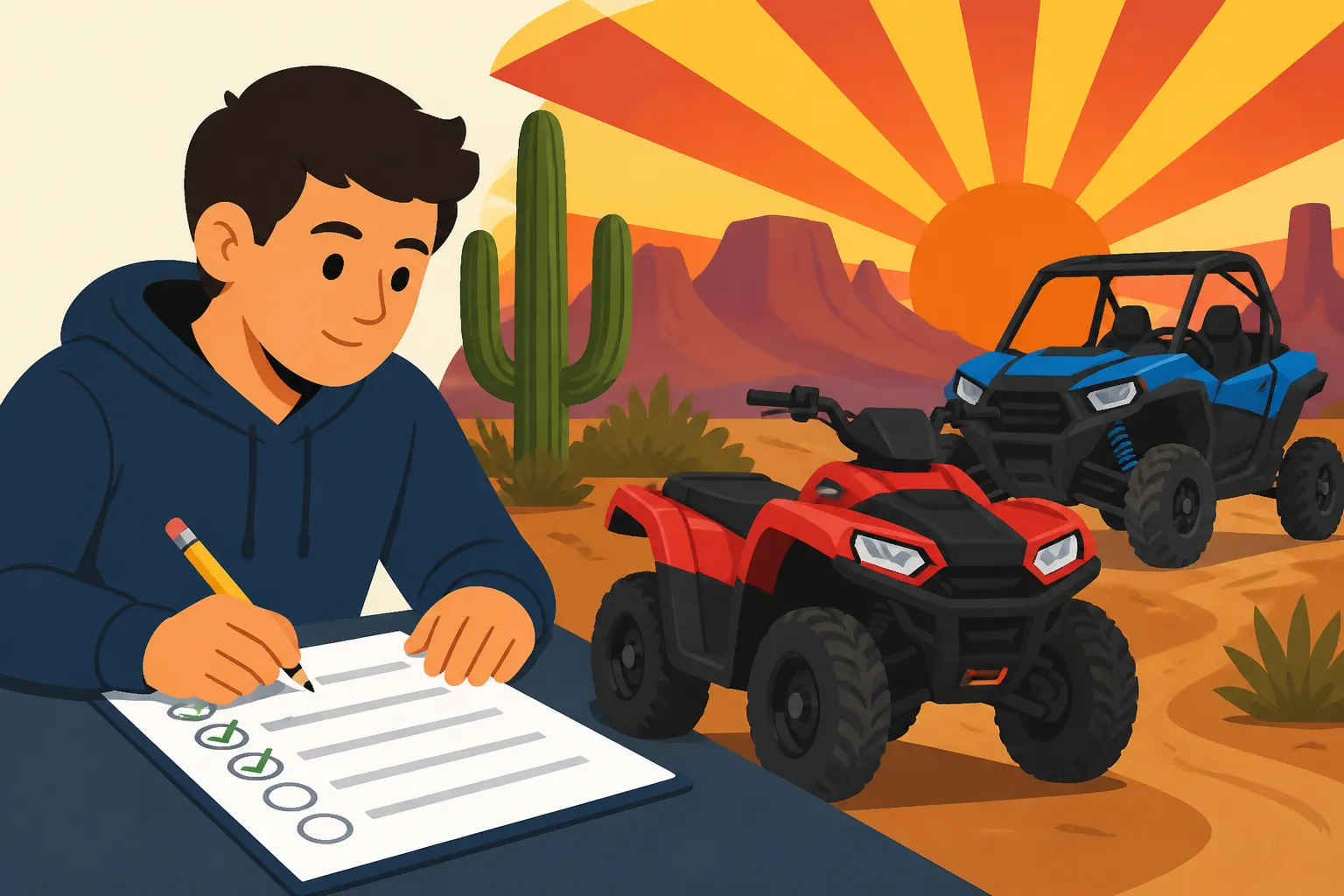
Written Testing Every Operator Takes
Arizona’s OHV written test can be confusing because riders may mistake it for a driver’s license exam or assume the same rules apply to every machine and riding location. The key is to understand how the knowledge check fits into Arizona’s safety-course requirements, who needs to complete it, and what to do before heading out.
What Arizona’s OHV written test is
The written test is a knowledge check associated with Arizona’s OHV safety education course. It covers safe, responsible riding rather than general road-driving skills. It is not an MVD written test, and passing it does not by itself give you a driver’s license, make a machine street legal, or grant permission to ride on land that is closed to OHVs.
The course is intended to help operators understand the responsibilities that come with riding, including how to use routes lawfully and reduce risks to people, property, and natural resources. Topics may include riding within your ability, sharing routes, basic equipment and safety practices, and recognizing that access rules depend on the land and route. Review the current course materials for the exact subjects and test format.
Arizona’s course and decal requirements can depend on the operator, the machine, and where it will be ridden. In particular, do not assume that registering a machine or holding an out-of-state registration answers every question about course completion. Start with Who Must Take the Arizona Decal Course and Arizona OHV Education Requirements to understand which requirements may apply to your situation.
| Question | Practical answer |
|---|---|
| Is the written test a driver’s license test? | No. It is a knowledge check connected to OHV safety education. |
| Does passing make an OHV street legal? | No. Street use has separate registration, equipment, insurance, and road-access rules. |
| Does an OHV decal automatically mean the course is complete? | Do not assume so. Check the current course and decal instructions for your operator and machine. |
| Does a course or decal open every route? | No. Land ownership, route designations, permits, and closures still control access. |
| Should you keep proof of completion? | Yes. Save the completion record and any confirmation the course provides. |
The test should be treated as a safety checkpoint, not a formality to click through. If the course explains a rule you do not recognize, pause and check the official material rather than guessing. A misunderstanding about a road crossing, a closed route, or the difference between public and private land can create problems even when the machine itself has the right paperwork.
It also helps to separate the course from other requirements. An OHV decal, a title, a registration plate, a state land permit, and course completion serve different purposes. Depending on where you ride, you may need more than one. For example, a decal does not replace a required permit for access to state trust land. Arizona State Trust Land Recreational Permits explains that separate access question.
Who needs to take it and when
The safest approach is to check the current Arizona Game and Fish course and decal instructions before each trip, especially if you are visiting from another state or riding a machine that belongs to someone else. Arizona’s requirements can differ by residency and riding context, and the rules for young operators include additional considerations.
If you are an Arizona resident, confirm whether the course requirement applies to you and how it relates to your machine’s registration and decal. If you are visiting, check the requirements for a nonresident rider rather than assuming your home-state paperwork is enough. The overview of Resident Decals Versus Visitor Decals in Arizona can help you identify which category to investigate.
Operators under 18 should pay particular attention to age-related requirements. Completing the written knowledge check does not necessarily satisfy every rule for a young rider. Supervision, helmet use, machine size, and any applicable skills-testing requirements are separate matters. Review Arizona Rules for Operators Under 18 and Skills Testing for a Rider With No License before a child or teenager rides.
The written test also should not be confused with whether a particular machine needs a decal. Machine type, weight, registration status, and where it is used can matter. A dirt bike, quad, and full-size side-by-side may have different paperwork questions, and an exception for one situation should not be generalized to another. If you are uncertain, use the official instructions for that machine and the planned riding area.
Private property is another reason to check the details. Rules that apply on public land may not apply in the same way to riding entirely on private ground, but that does not mean all requirements disappear. Permission, local rules, youth safety requirements, and the terms of a lease or property agreement can still matter. For state trust land, a decal or course completion alone does not establish permission to enter or ride.
Before taking the course, write down the basics of your situation:
- Is the operator an Arizona resident or a visitor?
- Is the operator under 18?
- What type of machine will be used, and how is it registered?
- Will the ride be on public land, state trust land, private property, or a mix?
- Does the route require a separate permit or have a current closure?
Those answers make it easier to follow the right set of instructions instead of relying on a friend’s experience with a different machine or location. If the rules are unclear, confirm them before traveling to the trailhead.
How to prepare for and complete the knowledge check
Use the official Arizona course rather than an unofficial quiz or a summary on a forum. The course is the place to confirm current requirements, instructions, and completion steps. The Safe and Ethical Riding in Arizona: the Course page is a useful starting point, and Arizona’s Free Mandatory OHV Decal Course provides more context on the course process.
A practical way to prepare is to read the course material carefully and connect each rule to a real riding decision. For example, ask yourself how you would confirm that a route is open, what you would do before crossing a road, and how you would respond if a marked route appears to continue into a closed area. Understanding the reasoning behind a rule is more useful than memorizing isolated phrases.
When you take the test:
- Read every question fully, including any conditions in the wording.
- Use the course material when a topic is unfamiliar instead of relying on memory.
- Pay attention to distinctions such as public land versus private land and a permitted route versus an unmarked track.
- Do not treat an answer as permission to ride a specific trail; verify the route’s current status separately.
- Follow the course’s instructions for recording or confirming completion.
The number and style of questions, any retake process, and the way proof is issued are details to check on the current course platform. Avoid relying on an old screenshot or a secondhand description if the site’s directions have changed. After completion, save the confirmation or certificate in a place you can access on the trip. A digital copy on your phone is useful, but keep it available offline if you expect to ride where cellular service is unreliable.
If you are arranging a group ride, each operator should verify their own course status. One person’s completion does not automatically cover a passenger who later drives, a second machine, or another adult in the group. A parent or trip organizer can help young riders complete the steps, but should still check the requirements for each operator and machine.
What passing the test does not replace
Passing the knowledge check is one part of being prepared; it is not a blanket authorization. Before riding, confirm the machine’s paperwork, any required decal, land-access permits, and route status. A machine can be properly registered yet still be ineligible for a particular route, and a rider can complete the course but still need a separate permit.
For a visitor, review Arizona Rules for Visiting Riders and the applicable nonresident decal guidance. For a resident, check the current registration and decal information rather than assuming a course record takes the place of registration. If you plan to ride on state trust land, check the permit rules and the exact location you intend to enter. Routes can cross different land types, so a ride that begins on one kind of property may require additional checks farther along.
Course completion also does not create road privileges. Riding on a public road or crossing one may involve separate equipment, registration, insurance, age, and access rules. A machine that is legal for off-highway use is not automatically legal for street use. See Street-Legal Registration Instead of a Decal for the distinction, and check the specific road rules before planning a town-to-trailhead route.
A simple pre-ride check can keep the different requirements straight:
- Confirm the operator has completed any required course and can access the completion record.
- Verify the machine’s registration and decal status.
- Check permits for every land type on the planned route.
- Confirm that the route is open to the machine you intend to ride.
- Review age, passenger, helmet, and equipment rules that apply to the operator and machine.
When requirements are unclear, use current official Arizona instructions before riding. Do not rely only on what another operator was allowed to do in a different year, county, or riding area. Rules and access conditions can vary, and a completed test does not override a posted closure or route restriction.
Disclaimer
This article is for general informational purposes only and does not constitute professional advice. Laws, prices and regulations vary by location and change over time. Consult a qualified professional for guidance on your specific situation.