Moss Wash OHV Trail
Moss Wash OHV Trail can look straightforward on a map, but desert routes around Mohave County can change character quickly: a firm track may become rocky, sandy, or difficult to follow, and a wash can turn dangerous after rain. This guide helps you plan a safer ride, check access, choose a suitable machine, and prepare for the conditions near Kingman.
Planning a ride on Moss Wash OHV Trail
Check the route before you leave
Start by confirming exactly which route you mean by Moss Wash and where you plan to enter and exit. Route names can be used informally, while maps may show a wash, a road, or a network of connected tracks. Don’t assume that a line on a phone map is an authorized OHV route. Check an official travel-management map for the land you’ll cross, and pay attention to closures, seasonal restrictions, and boundaries.
A route may pass between different land jurisdictions. That matters because access rules, permits, and permitted activities can change at a boundary. If your planned ride could cross Arizona State Trust Land, check whether a recreational permit is required; a vehicle decal alone does not necessarily provide permission to use every parcel. These steps can feel fussy when you’re eager to get moving, but they help prevent an accidental wrong turn onto closed or restricted land. Use [Finding the Right Travel Management Map] and [Reading an Arizona Motor Vehicle Use Map] as part of your pre-ride check.
A navigation app such as onX Offroad can help you follow a planned route and compare your position with mapped tracks. Treat it as a navigation aid, not proof that a road is open or that a trail is suitable for your machine. Download maps for offline use before heading out, and compare them with the land manager’s latest information. A screenshot or saved route is useful if your phone loses signal, but it should not replace checking access rules.
Check conditions and closures
Desert routes are not static. Rain can wash out a track, deepen a crossing, or leave loose material over a hard surface. Wind and traffic can also make a route harder to read. Before driving out from Kingman, check for current access notices and local conditions, and avoid relying only on an old trip report or a route somebody rode in a different season. [Checking Arizona Trail Status Before You Drive] is a useful companion for that last-minute review.
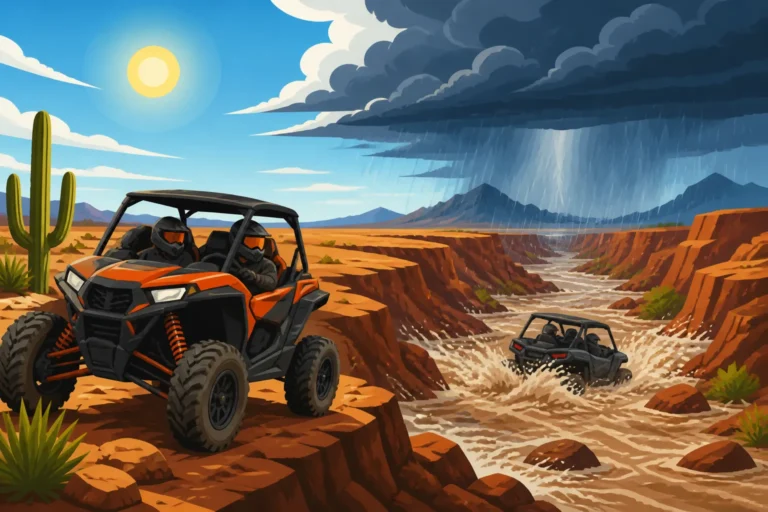
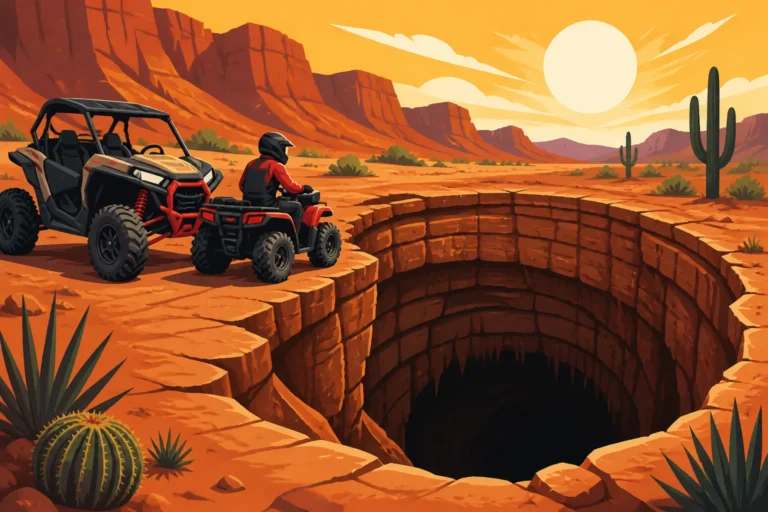
Be especially cautious around washes. Water can rush through a desert drainage even when the sky above you looks clear, because rain may have fallen upstream. If water is flowing, or you cannot tell how deep or soft a crossing is, don’t enter it. Turn around and choose another route. A ride is not worth getting trapped or swept into a hazard.
| Before the ride | What to confirm | Why it matters |
|---|---|---|
| Route and boundaries | The planned track is open and authorized for motorized travel | A visible track is not automatically a legal route |
| Land status | Who manages each section and whether a permit applies | Rules can change across land boundaries |
| Weather | Rain nearby, wind, heat, and forecast changes | Washes and exposed routes can become hazardous |
| Machine fit | Width, clearance, tires, fuel, and passenger capacity | A route that suits one machine may not suit another |
| Navigation | Offline maps, backup power, and a second navigation method | Cell service may be unreliable outside town |
| Group plan | Meeting point, turnaround time, and emergency contact | A clear plan helps if riders get separated |
Choosing a machine and preparing your gear
Match your ATV or UTV to the terrain
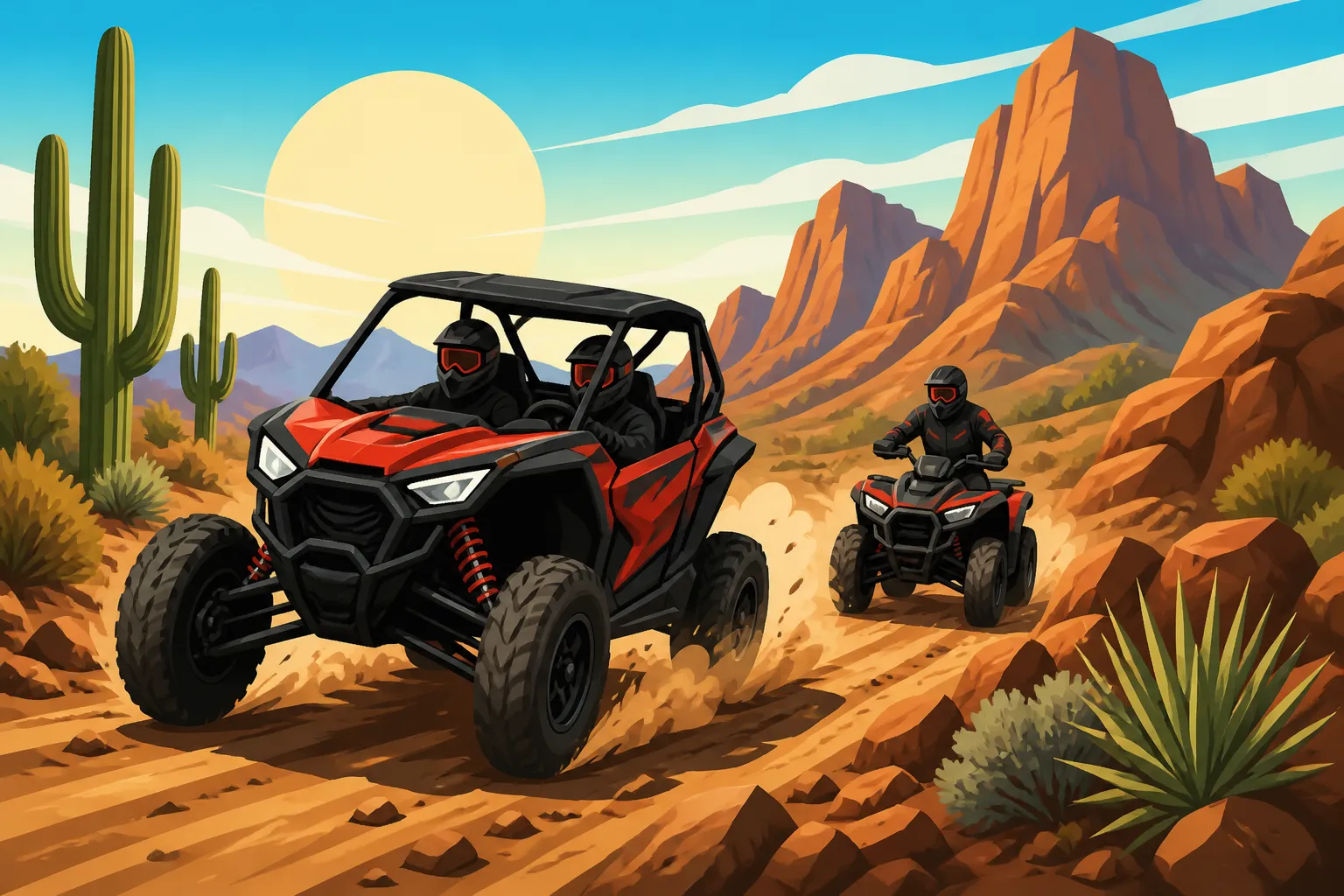
Don’t choose a machine based only on engine size or how capable it looks in a parking lot. Think about ground clearance, tire condition, turning room, rider experience, and whether the route includes rough sections. A compact ATV can be easier to maneuver in tight turns, while a side-by-side may offer a passenger seat and more room for supplies. Neither type makes a poor route choice safe.
If you’re taking a full-size UTV, confirm that the tracks you intend to use allow its width and that there is room to turn around. A route that appears broad on a small screen may narrow between rocks or along a wash edge. Check vehicle-width limits and route information before setting out; [Arizona Trails Rated for Full-Size Rigs] can help you think through machine fit. If you rent, ask the shop which routes are permitted for its machines and whether any local restrictions apply.
Inspect the machine before the ride, especially if it has been sitting or recently transported. Look at the tires and wheels, test the brakes and lights, check fluid levels, and make sure the throttle returns smoothly. For a UTV, confirm that seats, belts, doors or nets, and other passenger restraints are ready to use. A quick walk-around in the staging area is much easier than discovering a problem far from pavement.
Carry the essentials for a remote ride
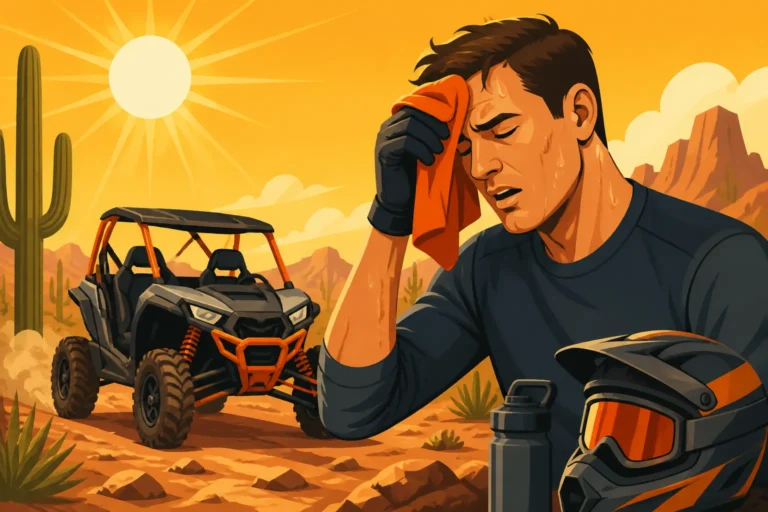
Bring more water than you expect to need, along with sun protection and a first-aid kit you know how to use. Pack enough food for a delay, even if you’re planning a short loop. A small tool kit, tire-repair supplies, a suitable spare, and recovery equipment can make a minor problem manageable. Make sure you know how to use any winch or recovery strap before you need it. [Water Planning for an Arizona Trail Day] and [Flat Tires From Sharp Desert Rock] cover two common desert-ride concerns in more detail.
Navigation needs a backup. Save maps offline, keep your phone charged, and carry a power bank. Tell someone where you plan to ride and when you expect to check in. If your group is going beyond reliable cell coverage, consider whether a satellite messenger is appropriate for the trip. Don’t count on being able to call for help from every wash or ridge.
Clothing should protect you from sun, dust, and abrasion while allowing you to move comfortably. Wear a properly fitted helmet and eye protection, and use clothing suited to the machine and conditions. Pack an extra layer if you expect to be out late or travel into cooler elevations. Dust can be tiring even on a short ride, so goggles or a face covering may make the day more comfortable.
Riding safely and responsibly near Moss Wash
Use a steady pace and a conservative plan
At the start of the ride, give yourself time to learn the surface. Loose gravel, embedded rock, and soft sand can affect steering and braking differently from pavement. Keep a speed that lets you stop within the distance you can see, and leave enough space between machines to avoid dust and sudden stops. Oncoming traffic, livestock, and other trail users may appear around a bend with little warning.
In a group, agree on a lead rider and a sweep rider, and discuss what you’ll do if someone loses sight of the group. Stop at safe pullouts rather than blocking a route. Set a turnaround time before you begin, particularly if the ride is new to you. It’s easy to stretch a planned outing with “just one more turn,” but that can leave the group navigating in fading light or running short on water.
Avoid pushing through an unfamiliar obstacle just because another machine made it across. A larger UTV, an experienced rider, or a different line may handle the same spot differently. Walk a route when it is safe to do so, assess the approach and exit, and choose the easier option if you’re unsure. Turning around is a sound riding decision, not a failure.
Protect the land and respect other users
Stay on authorized routes. Creating a new bypass around a rut or obstacle can widen damage and may cross protected or private ground. Don’t spin tires to climb a loose slope, cut across vegetation, or leave trash behind. In the desert, tracks can remain visible long after a ride, so staying on established routes matters.
Keep noise and dust in mind near homes, camps, and other visitors. Slow down around people, animals, and parked vehicles. Give other users room to pass, and avoid revving engines unnecessarily at a staging area. If you encounter a gate, closure sign, or route marker that conflicts with your plan, stop and reassess rather than assuming the sign does not apply.
Before your trip, review [Arizona's Spark Arrestor Requirement] and any other equipment or operating rules that apply to your machine and riding location. Requirements can depend on where you ride and how the vehicle is registered or used. Also confirm the applicable OHV decal and land-permit rules rather than assuming a plate, decal, or permit covers every kind of access.
A practical checklist for your trip
The day before you go
Check the route, land status, weather, and any closure information. Decide on a conservative loop with a clear turnaround point, then save the route for offline navigation. If you’re meeting others, confirm the staging location and communicate the plan to someone who is not riding with you. [Arizona Trailhead Parking and Staging] can help with the practical details of getting a group and its vehicles ready.
Look over the ATV or UTV and pack water, food, first aid, navigation, sun protection, and repair gear. Make sure everyone understands the route plan and knows what to do if the group stops or separates. If you’re uncertain whether a machine can handle the planned terrain, change the route rather than hoping the trail will be easier than it looks.
At the staging area and on the trail
Before unloading, make sure you are at an appropriate staging location and not blocking a gate, road, or access point. Confirm that the group has the right maps and knows the first meeting point. Once you begin, ride at a pace that suits the least experienced person in the group, stop for water, and adjust the plan if conditions are different from what you expected.
Keep checking your surroundings instead of focusing only on the navigation screen. A mapped track can help you stay oriented, but it cannot tell you whether a wash is safe to cross at that moment or whether a loose climb is beyond your comfort level. If you’re using onX Offroad, keep it available as one part of your navigation setup while staying alert to signs, closures, and actual ground conditions.
Moss Wash is best approached as a ride to plan carefully, not a route to assume will be simple because it appears close to town. Verify access, prepare for desert conditions, and be willing to turn around when the terrain or weather calls for it. That small amount of preparation can make the difference between a relaxed day near Kingman and a difficult trip that could have been avoided.
Disclaimer
This article is for general informational purposes only and does not constitute professional advice. Laws, prices and regulations vary by location and change over time. Consult a qualified professional for guidance on your specific situation.