When Arizona Low Desert Riding Is Best
Arizona’s low desert can shift from comfortable riding weather to punishing heat within a single season, and a date that works near Phoenix may feel very different near Lake Havasu. This guide explains how to choose a riding window, plan around daylight and weather, and check local conditions before hauling your ATV or UTV to a trailhead.
How Arizona’s Low Desert Seasons Affect Riding
Winter is usually the easiest season to plan around
For many riders, winter is the most comfortable time to explore low-elevation desert routes. Daytime conditions can be pleasant for longer outings, and cool mornings make it easier to load up, air down tires, and start riding before the day gets busy. The trade-off is that cold mornings and evenings can catch visitors off guard, especially if they are used to a warmer climate.
Winter also tends to bring more riders to popular areas. A holiday weekend or a clear Saturday can mean busy staging areas, dustier traffic, and more people sharing narrow routes. If you are planning a trip near Phoenix, Lake Havasu City, or Parker, an early start and a flexible route plan can make the day feel less rushed. For a broader seasonal overview, see [Arizona's Best Riding Months].
Spring and fall can be excellent, but timing matters
Spring and fall often offer comfortable stretches for desert riding, but temperatures can change quickly as the season turns. A route that feels mild in the morning may become hot and tiring by midday, particularly if you are riding at lower elevations with little shade. Check the forecast for the actual area you plan to visit rather than relying on conditions in Phoenix or another larger city.
These shoulder seasons can also attract groups planning weekend trips, so consider trailhead parking and route popularity when choosing your day. If your schedule is flexible, a weekday may offer a quieter experience. Seasonal guidance in [Best Months for Arizona Desert Riding] can help you compare the broader timing patterns, while [Riding the Sonoran Desert Near Phoenix] is useful if you are deciding where to ride closer to the Valley.
Summer can narrow the safe riding window
Summer is the season that calls for the most caution in Arizona’s low desert. High temperatures can make even a short ride feel strenuous, and the combination of heat, sun exposure, dust, and physical effort can catch riders off guard. A UTV’s roof or a breeze from moving may feel helpful, but neither removes the risk of heat illness.
Some riders choose not to ride low-elevation trails during the hottest periods. Others plan only a short outing at dawn, carry more water than they expect to need, and turn back early rather than trying to complete a long route. If the forecast looks extreme, changing the plan is a sound decision—not a failure to make the most of the trip. For seasonal planning beyond the low desert, [Why Arizona Riders Follow Elevation in Summer] explains why higher elevations may be a better option during the hottest part of the year.
| Season | General riding outlook | Main planning concern | Practical approach |
|---|---|---|---|
| Winter | Often comfortable for longer outings | Cold starts and popular weekends | Start early, bring warm layers, and expect company |
| Spring | Often favorable, with warming afternoons | Heat building later in the day | Plan a morning ride and shorten the route if needed |
| Summer | Heat can make low-desert riding unsafe | Heat illness and fast-changing weather | Consider postponing or choosing a cooler elevation |
| Fall | Can offer comfortable riding as temperatures ease | Conditions vary as the season changes | Check the local forecast and avoid assuming every day is mild |
Choose the Time of Day as Carefully as the Season
Start early without rushing the preparation
A dawn departure can help riders make better use of cooler hours, especially in warmer months. But “start early” should not mean skipping basic checks. Before leaving, confirm that the machine is ready, everyone knows the route, and your group has the water, food, communication gear, and recovery supplies it needs. A rushed launch can turn a simple issue—like a low tire or an overlooked water bottle—into a bigger problem once you are away from the staging area.
Give yourself enough time to unload and prepare before riding. Check tire condition, fuel, lights, and any essential safety equipment. Review where you intend to turn around and agree on a latest return time. [Dawn Rides Before the Heat Builds] covers the value of early starts, while [Water Planning for an Arizona Trail Day] can help you think through hydration before you leave the pavement.
Keep the midday plan flexible
Even outside the hottest part of summer, the afternoon can feel very different from the morning. This is especially true on open routes where riders have limited shade and are exposed to sun and reflected heat from the ground. Long stops beside a machine can also become uncomfortable if the group has not brought enough water or sun protection.
Build an early turnaround into the plan instead of treating the farthest point as a goal you must reach. If a rider becomes unusually tired, dizzy, nauseated, confused, or unsteady, stop in a safe place and take the situation seriously. Do not assume that continuing at a slower pace will solve a developing heat problem. The safest route plan is one that can shrink when conditions demand it.
Match daylight to route difficulty
Shorter winter days leave less daylight for getting back to camp, a trailer, or a paved road. That matters on unfamiliar routes, where navigation mistakes or a mechanical issue can add time. A route that appears manageable on a map can take longer when the group stops for photos, helps a rider, or works through rough terrain.
Before setting out, estimate how long the whole outing could take—not just the moving time. Add room for breaks and unexpected delays, then set a turnaround time that leaves a comfortable daylight margin. Carry a charged phone and navigation device, but do not assume either will have reception everywhere. On remote routes, tell someone where you are going and when you expect to return.
Understand Desert Weather and Ground Conditions
Check for rain and monsoon risk
Desert weather can affect a ride even when the trailhead looks dry. Rain falling farther up a drainage can send water into a wash, and a route that was passable earlier may become unsafe. Monsoon-season storms can bring sudden downpours, lightning, strong winds, dust, and localized flooding. Never use a dry-looking wash as proof that it is safe to cross.
If storms are possible, watch the forecast for the full riding area, not just the nearest town. Be willing to cancel or change plans when conditions are uncertain. If water is moving across a route, do not try to drive through it or wait in the channel to see what happens. Move to higher ground and follow current local safety guidance. For more on seasonal storm risk, see [Arizona Monsoon Season and Flash Flooding] and [Flash Flooding in a Desert Wash].
Dust, rain, and wind can change the ride
Dry conditions often mean dust, especially where multiple machines are moving along the same route. Leave plenty of space between vehicles and slow down if visibility drops. Avoid following so closely that you are riding in another machine’s dust cloud; the driver ahead may also have limited visibility and may brake or turn unexpectedly.
Rain can improve traction on some surfaces, but it does not automatically make every route easier. Wet clay, slick rock, mud, and rutted ground can create handling challenges, and runoff can damage trails or block access. Strong wind can add dust and make exposed sections less comfortable. A practical plan includes permission to turn around, pick another route, or call the ride off when the weather changes.
Check current access before driving out
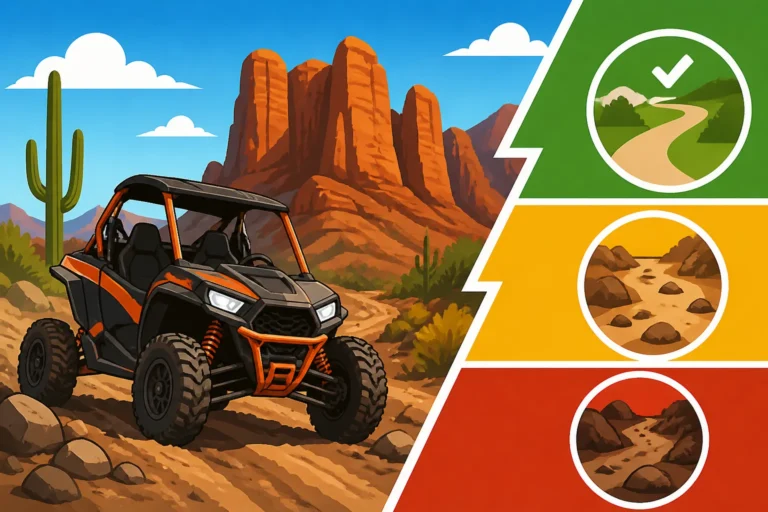
A route name or old trip report does not guarantee that a trail is open or suitable today. Closures, fire restrictions, maintenance, land boundaries, seasonal conditions, and local rules can affect where motorized vehicles may travel. Confirm the land manager’s current information and use maps that clearly distinguish designated routes from areas where riding is not allowed.
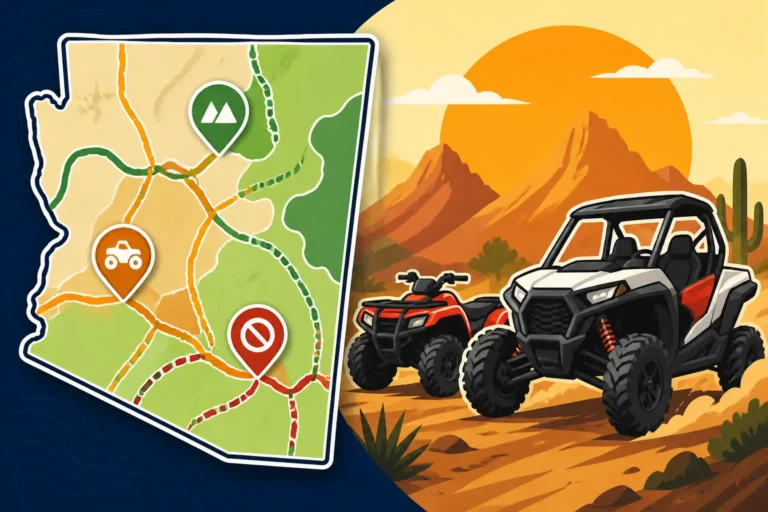
Navigation tools can help with route planning, but a line on a screen is not permission to ride everywhere it appears. Use [Checking Arizona Trail Status Before You Drive] as a reminder to verify access before departure. Some riders use onX Offroad to review mapped routes and orient themselves, but they should still confirm land access, closures, and local rules through the relevant official information before riding. A downloaded map can be useful where cell service is unreliable, but it cannot replace good judgment on the ground.
Pick a Low-Desert Area That Fits the Day
Near Phoenix, plan around access and the urban edge
The Sonoran Desert near Phoenix offers opportunities for desert outings, but the metro area’s size can make it easy to underestimate the drive, trailhead conditions, and access rules. Decide which area you intend to visit before setting out, and confirm that the route is open to your type of machine. Do not assume that an open-looking track is a legal OHV route simply because it is visible on a map.
A morning ride can be a good fit when you want to avoid the hottest part of the day or finish before traffic builds on the drive home. Bring enough fuel for the full plan, including any detours, and identify a backup route in case the intended access point is crowded or unavailable. [Riding the Sonoran Desert Near Phoenix] offers more location-focused context for planning closer to the Valley.
Around Parker and Lake Havasu, check each area separately
The Parker and Lake Havasu region is not one uniform riding area. Routes, terrain, access, and local conditions vary, so check details for the specific place you plan to visit. A route that suits a confident group in suitable weather may not be a good match for a first-time rider, a stock machine, or a day when visibility and traction are poor.
Standard Wash near Lake Havasu City and Crossroads near Parker are examples of named OHV areas that riders may consider, but conditions and access can change. Check current land-manager information, staging details, and any applicable requirements before towing there. See [Standard Wash Near Lake Havasu City] and [Crossroads OHV Area Near Parker] for area-specific planning topics. Bring a printed or offline backup for navigation if your route depends on a phone signal.
Match the route to the group, not just the machine
A capable ATV or UTV does not automatically make a difficult route appropriate for everyone in the group. Consider the least experienced rider, passenger needs, machine width, ground clearance, fuel range, and how comfortable the group is with sand, rocks, steep sections, or exposed terrain. If people disagree about difficulty, choose the more conservative route.
For mixed-experience groups, agree on a pace and regrouping points before leaving. Keep the group together without tailgating, and make sure every driver knows how to stop safely if they lose sight of the machine ahead. A shorter loop with time for breaks often makes a better day than a longer route that leaves the group tired, stressed, or racing the daylight.
Build a Practical Low-Desert Riding Plan
Prepare for heat, dust, and minor problems
Pack for the conditions you may encounter, not only the weather at the house. Water, sun protection, sturdy clothing, eye protection, a first-aid kit, food, and a way to navigate are useful foundations. Add equipment that matches your machine and route, such as a tire repair kit, basic tools, recovery gear, and spare communication power. Keep important items accessible rather than buried under luggage.
Before leaving, tell someone outside the group where you plan to ride and when you expect to be back. If the route changes, update them when possible. Make sure each driver understands how to stop, signal, and regroup if the group becomes separated. These small preparations matter most when something goes wrong far from services or cell coverage.
Use a simple go-or-no-go check
On ride day, take a moment to assess conditions honestly. Check the forecast, look for closure notices, confirm the route is suitable for your group, and ask whether anyone is already tired, dehydrated, or uncomfortable. If the plan depends on perfect weather, perfect navigation, or everyone feeling strong all day, it may be too ambitious.
A useful pre-ride check is to ask:
- Is the route open and legal for our machines?
- Are weather, temperature, wind, and visibility suitable?
- Do we have enough water, fuel, and daylight for the full outing?
- Can the least experienced rider manage the terrain?
- Does everyone know the turnaround point and what to do if the group separates?
If any answer raises a serious concern, adjust the plan before unloading or choose another day. Arizona’s low desert will still be there; pushing ahead through unsafe conditions is rarely worth the risk.
Make the ride enjoyable by leaving room to adapt
The best low-desert ride is not necessarily the longest or most technical. It is the one where the group returns with enough energy to enjoy the rest of the day, the machines are still in good shape, and nobody had to make a risky decision just to stay on schedule. Shorter loops, early returns, and backup plans are signs of thoughtful preparation.
Conditions vary from one route to another and from one day to the next. Choose your season and start time carefully, verify access, and be prepared to change plans when the desert gives you a reason. That flexibility is especially valuable in Arizona, where heat, dust, wind, and sudden storms can turn a promising forecast into a very different day on the trail.
Disclaimer
This article is for general informational purposes only and does not constitute professional advice. Laws, prices and regulations vary by location and change over time. Consult a qualified professional for guidance on your specific situation.