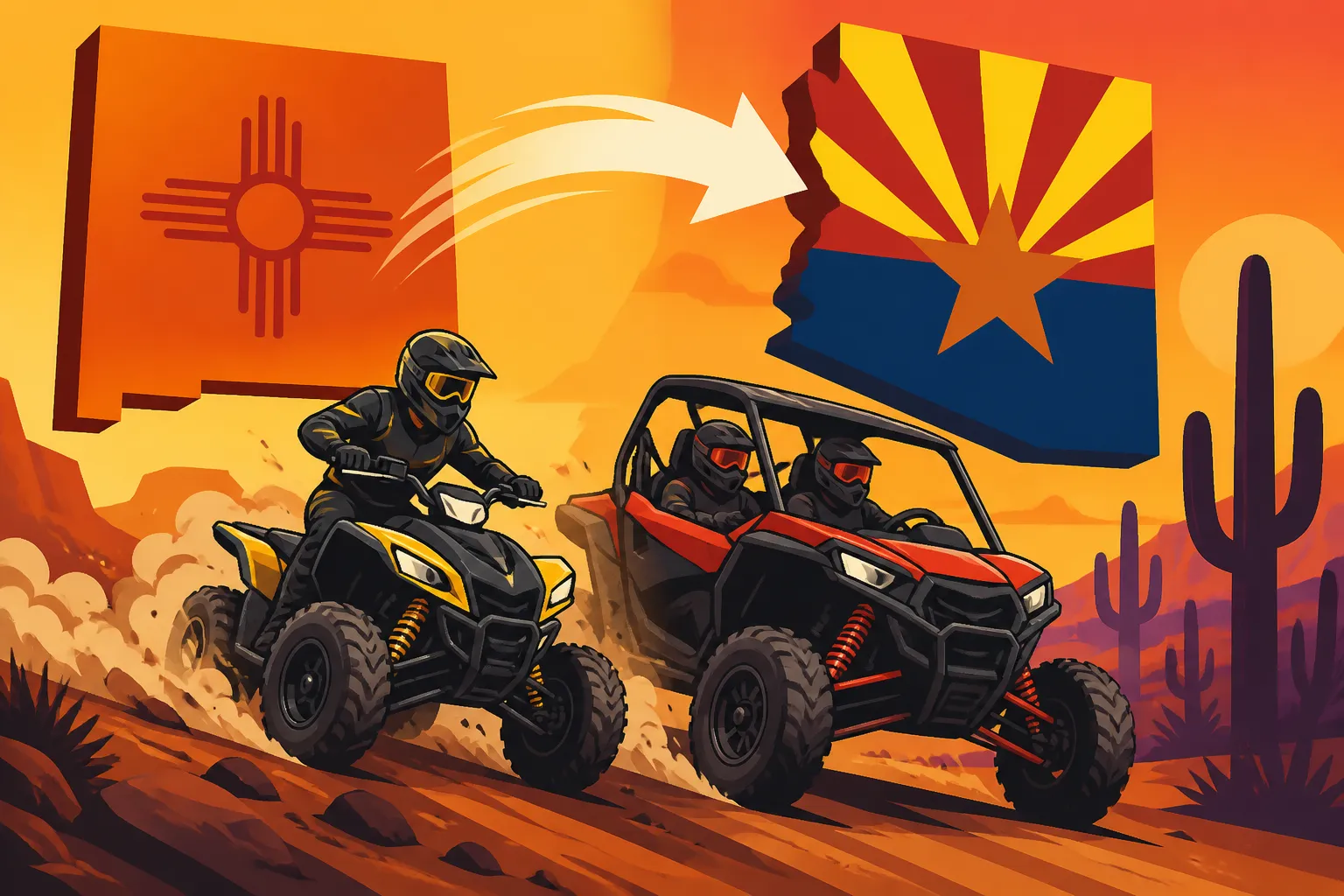
New Mexico Riders Coming to Arizona
New Mexico riders heading into Arizona need to sort out more than the route and the fuel stop. The right decal depends on how the ATV or UTV is registered, while a decal alone does not grant access to every trail or parcel. Here’s how to check your machine’s status, handle Arizona’s requirements, and avoid arriving at a gate without the paperwork you need.
Does a New Mexico Machine Need an Arizona OHV Decal?
The first question is whether your machine is registered for street use or is an off-highway-only vehicle. Arizona treats those situations differently. A valid street-legal registration and plate from another state may satisfy the registration requirement in place of an Arizona OHV decal. An off-highway-only machine generally needs Arizona’s nonresident OHV decal when it is operated where the decal is required.
Do not assume that a New Mexico registration sticker, OHV permit, or proof of purchase automatically counts as street-legal registration in Arizona. Check what your registration actually authorizes and whether the machine has a valid plate. A vehicle that is registered only for off-highway use is not necessarily treated like one registered for road use.
| Your machine’s status | What to check before riding in Arizona |
|---|---|
| Registered and plated for street use in New Mexico | Confirm the registration is current and the vehicle is legally configured for street use. Check whether that status exempts it from the Arizona OHV decal. |
| Registered only for off-highway use in New Mexico | Plan to obtain Arizona’s nonresident OHV decal if required for the land and riding you have planned. |
| Unregistered, or paperwork does not clearly show its status | Resolve the status before the trip. Do not treat a bill of sale or New Mexico sticker as a substitute for required Arizona documentation. |
| Rented or borrowed machine | Ask the owner or rental provider which registration and decal requirements apply. Confirm the decal is assigned to the machine you will ride. |
The practical takeaway: a New Mexico OHV credential is not a dependable substitute for Arizona’s nonresident decal on an off-highway-only machine. If your machine is street legal, verify that its registration is current and that it qualifies for the applicable exemption. If you are uncertain, ask Arizona Game and Fish or Arizona Motor Vehicle Division before you travel rather than trying to settle the question at a trailhead.
The distinction between a plate and an off-highway decal can be confusing. Street-Legal Plates in Place of an Arizona Decal explains the general distinction, and Resident Decals Versus Visitor Decals in Arizona covers how Arizona treats residents and visitors differently. For a broader overview of Arizona’s rules, see What Arizona Riders Need Before They Ride.
Arizona’s decal requirement is not the only rule that can apply. The machine still needs to be allowed on the route you use, and the land manager may set additional access conditions. For example, a valid decal does not make a closed road legal to ride, authorize travel in a wilderness area, or substitute for a land-use permit where one is required.
How to Get the Nonresident Decal and Prepare Your Paperwork
If your ATV or UTV needs an Arizona nonresident OHV decal, buy it through the official Arizona Game and Fish process before setting out. The state’s portal provides the current instructions, purchase conditions, and any education-course steps that apply. Check those details directly, because requirements and processing arrangements can change.
A decal is associated with a particular machine. If you are bringing more than one ATV or UTV, check whether each one needs its own decal. Do not assume a decal purchased for one machine can be moved to another, even if both machines belong to the same rider. If you are traveling with friends or family, make sure every vehicle’s paperwork is sorted separately.
Use this sequence to reduce last-minute problems:
- Confirm the machine’s registration status. Check the New Mexico registration document and determine whether the machine is registered for street use or off-highway use only. Make sure the vehicle identification number and registration details match the machine.
- Check Arizona’s current decal rules. Use Arizona Game and Fish’s official portal to see whether your machine needs a nonresident decal and what information is required.
- Complete any required course steps. Arizona has OHV education requirements that may affect operators or decal applicants. Follow the current instructions in the portal, and do not assume that a New Mexico course or credential automatically satisfies an Arizona requirement.
- Allow time for the decal. Check how the decal is issued and when you should expect it. If it is mailed, avoid planning to ride before it arrives unless Arizona’s official guidance clearly says you may.
- Attach it as directed. Follow Arizona’s placement instructions for the machine. A decal that is valid but not displayed as required can still create trouble during an inspection.
- Keep your records accessible. Carry or have ready the registration, proof of purchase, decal information, and any other documents that show the machine’s status.
For help with the online process, The Arizona Game and Fish Portal Account explains the account riders may need, and Buying a Non-Resident Decal Online Only covers the purchase channel. If the education step applies to you, check Who Must Take the Arizona Decal Course and Safe and Ethical Riding in Arizona: the Course for related information. The official portal remains the place to confirm current eligibility and steps.
A street-legal plate does not mean every feature of the vehicle is automatically compliant in Arizona. If you plan to ride on roads, confirm that the machine is properly registered and equipped for the type of road use you intend. Arizona has specific requirements for road-legal machines, and New Mexico’s rules do not necessarily answer every Arizona question. What Arizona Requires on a Street-Legal Machine is a useful starting point.
If your machine is an off-highway model and you are unsure whether a previous owner’s paperwork is complete, address that before departure. A bill of sale helps show a purchase, but it may not establish all the registration rights or ownership history needed for a particular transaction. Proof of Ownership for an Arizona Title discusses the kinds of ownership records that matter when paperwork is incomplete.
Decal, Land Access, and Route Rules Are Separate Checks
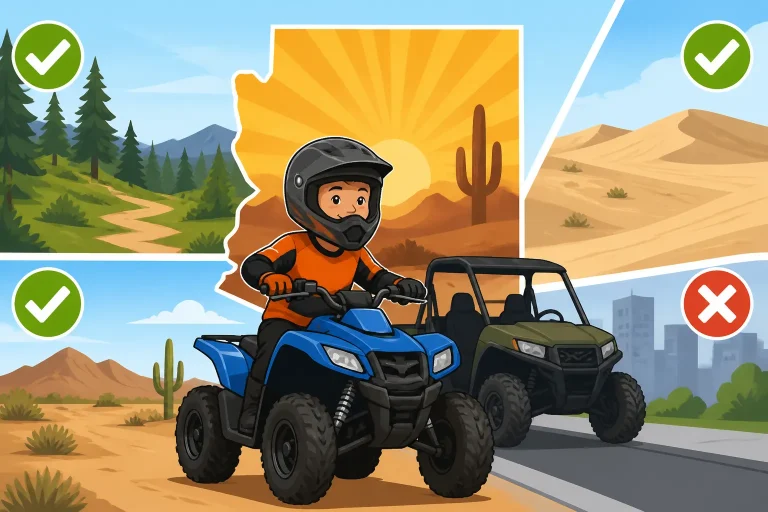
A common planning mistake is treating the OHV decal as a pass for all Arizona public land. It is not. The decal addresses a vehicle requirement; access depends on where you intend to ride and the rules for that specific area. Forest Service land, Bureau of Land Management land, state trust land, state parks, tribal land, and private property may each have different routes, permits, closures, or restrictions.
State trust land deserves special attention. An Arizona OHV decal does not by itself grant permission to use trust land for recreation. Check whether you need an Arizona State Land Department recreational permit, and confirm that the parcel and activity are covered. A permit does not open every road or parcel, either; access may be limited by land status, posted restrictions, or an active closure. See Arizona State Trust Land Recreational Permits and Why a Decal Alone Will Not Let You Stage before planning to unload or ride on trust land.
On federal land, use the current travel management information for the area. A road that appears on an old map, a GPS track, or a riding app may have been closed or may not be open to your vehicle type. Confirm whether the route allows your machine’s width and class, and check seasonal closures, fire restrictions, and any local permit requirements. Finding the Right Travel Management Map and Checking Arizona Trail Status Before You Drive can help with that planning.
Before leaving New Mexico, make a short access checklist:
- Identify the land manager. A trailhead’s general location does not always tell you who manages the land or which rules apply.
- Check the route, not just the destination. Your planned route may cross parcels or roads with different access rules.
- Confirm machine fit. Width restrictions can rule out a route even when the area is open to OHVs generally.
- Check permits and closures. Look for current official notices, including fire-related restrictions and temporary closures.
- Plan the staging location. Permission to ride in an area does not necessarily mean you can park a truck, trailer, or toy hauler wherever it is convenient.
- Keep a backup route. If a gate is closed or the trail is restricted, use a legal alternative rather than riding around the barrier.
These checks matter for New Mexico riders because state lines do not carry access privileges with them. A route or permit that works at home may not apply in Arizona, and a map app may not show every current restriction. If you are bringing a larger side-by-side, check width rules before committing to a trail. Arizona Trails That Suit a 50-Inch Machine and Arizona Trails Rated for Full-Size Rigs can help narrow down route choices.
A Practical Pre-Trip Check for New Mexico Riders
A few days before departure, confirm the essentials together rather than treating registration, decals, and access as separate errands. Start with the machine’s documents, then verify the decal requirement, and finish by checking the exact land and route. If you are traveling in a group, make sure every rider and machine has been checked; one vehicle’s valid paperwork does not cover the rest.
Keep a copy or accessible image of your registration documents, but do not rely on a phone screenshot as a substitute for a decal that must be displayed on the vehicle. Check the official instructions for whether the decal must be physically attached before riding. Also keep emergency contacts, route details, and a backup plan available in case cell service drops.
If you are borrowing a machine, ask the owner to confirm its registration classification and decal status before you load it. If you rent, ask the rental provider whether the machine is covered for your chosen route and whether any decal or permit steps are your responsibility. A rental agreement may set additional route limits even where public access is otherwise allowed.
Finally, check conditions close to the day you ride. Arizona weather, fire restrictions, road work, and land closures can affect access after you have made your plans. In desert areas, heat, long distances, and limited cell service make a wrong turn more than an inconvenience. Carry enough water and recovery equipment for the route, tell someone where you plan to ride, and do not continue onto a route that is closed or unclear.
For most New Mexico visitors, the decision can be reduced to three questions:
- Is the machine currently registered and plated for street use, or is it off-highway-only?
- Does Arizona require a nonresident OHV decal or course step for this machine and rider?
- Are the specific land, route, and staging area open to this machine, with all required permits in place?
Answer those questions before crossing the state line, and you are much less likely to confuse a New Mexico registration with Arizona authorization. When the paperwork does not clearly establish the machine’s status, verify it with the appropriate Arizona agency before riding.
Disclaimer
This article is for general informational purposes only and does not constitute professional advice. Laws, prices and regulations vary by location and change over time. Consult a qualified professional for guidance on your specific situation.